Last updated 2026-08-19
TL;DR
A commercial dry stack in Georgia is a multi-million site project, not a state license. You file an LLC ($100 at the Secretary of State), then stack local zoning, EPD stormwater, and either a Coastal Marshlands permit or a USACE lake outgrant. Paper can take months. Water work can take more than a year. Confirm live fees with each board.
How much does a dry stack marina cost in Georgia?
There is no official Georgia price tag. A working commercial dry stack is almost always a multi-million dollar project once you add waterfront land or a lake lease, a rack building, a marine forklift, launch infrastructure, and first-year payroll. State filing fees are small. The steel, dirt, and permits are not.
I will not invent a statewide average. Nobody publishes a clean Georgia-only dry stack budget that you can take to a bank. Land on Lake Lanier is a different planet from a back canal in Glynn County or a private pond in the Piedmont. Bids move with steel, insurance, and whether you already have deep water and zoning.
What you can pin down is the paper cost and the cost buckets. Georgia Secretary of State charges $100 to file articles of organization for a domestic LLC. [1] Annual registration is published at $50. [2] Those numbers are real and they are also a rounding error on a rack building.
The money lives in five piles: control of the ground (purchase, ground lease, or USACE outgrant), civil and water work, the rack structure, the marine forklift and launch well, and a year of people plus insurance. On any site that already has boat demand, the first four piles together routinely clear seven figures before you store a customer's boat. If a broker quotes a turnkey number without a geotech report, a flood map, and a written read from the lake manager or Coastal Resources Division, walk.
Compare method, not budgets, with dry stack marina cost in Florida or dry stack marina cost in Alabama. Georgia water law and lake ownership do not match either neighbor one for one.
Do you need a license for a dry stack marina in Georgia?
No. Georgia does not issue a single statewide dry stack marina license. You form a business, you pay local occupation tax where the city or county levies it, and you collect land-use, building, environmental, and (if you are in the water) federal permits. Calling that one license is how people miss a year.
Start with the entity. Most operators use a domestic LLC. Articles of organization cost $100 at the Secretary of State. [1] You still need a registered agent and an annual registration. [2]
Local governments levy occupation taxes under Title 48 of the Georgia Code. [3] There is no uniform state business license sitting on top of that. Savannah, Brunswick, Gainesville, and a rural county will not hand you the same form or the same rate.
If your racks, launch, or bulkhead sit on or over coastal marshlands in the estuarine area, Georgia law is blunt. O.C.G.A. § 12-5-286 says, "No person shall remove, fill, dredge, drain, or otherwise alter any marshlands or construct or locate any structure on or over marshlands in this state within the estuarine area without first obtaining a permit from the committee." [4]
Inland Corps reservoirs swap that coastal committee for a shoreline and real estate process. USACE shoreline policy is written in ER 1130-2-406, not in a city business license office. [5]
Forklift work inside the building is still powered industrial truck work under OSHA 29 CFR 1910.178. [6] That is a federal safety standard, not a Georgia marina card you hang on the wall.
How long does a dry stack marina take in Georgia?
Nobody should sell you a guaranteed Georgia clock. Forming the LLC can be done in days after a complete filing. [1] A clean upland building permit on land that is already zoned for the use can take a few months. Water work, marsh alteration, or a new commercial outgrant on a USACE lake can take more than a year, and some commercial lake opportunities are simply not available.
Treat the path as stacked gates, not a single queue. Entity and tax accounts first. Then zoning and floodplain. Then environmental and federal real estate. Then building and fire. Then you buy steel.
Coastal Marshlands applications go to a committee, not a clerk with a 10-day stamp. [4] Corps regulatory review under Section 10 of the Rivers and Harbors Act starts from a simple legal fact. 33 U.S.C. § 403 states, "The creation of any obstruction not affirmatively authorized by Congress, to the navigable capacity of any of the waters of the United States is prohibited." [7] If your launch well, pile, or float sits in navigable water, that statute is in play.
Individual permits take longer than nationwide permits. I will not quote a fake median day count. Ask Savannah District or Mobile District which permit type they think you are in, and get it in writing.
Construction itself, once paper is done, is a metal building and rack job plus marine equipment. That can be three seasons or one, depending on weather, steel lead time, and whether you already have a bulkhead. Do not use a blog timeline as a bank covenant. Confirm every clock with the board that actually stamps the file.
What permits sit on a Georgia dry stack, not a national checklist?
The real stack is local land use, state environmental coverage, and federal water or lake real estate. A printed marina permit list from another state will waste your time. Georgia splits coastal estuarine work and inland reservoir work, then still makes you talk to the county.
On land you need zoning approval and a building permit under Georgia's statewide minimum construction codes, administered locally. [12] If the site is in a mapped floodplain, the community's floodplain ordinance applies on top of the building official. Skip that meeting and you redesign the finished floor elevation after steel is ordered.
If you disturb one acre or more, Georgia EPD's construction stormwater NPDES permit is the usual coverage. [14] Once you are operating a working yard with equipment washing or vehicle maintenance, ask EPD whether the industrial stormwater general permit applies to your NAICS and activities. [10] Do not guess from a SIC list you found in a forum.
Any USACE permit typically pulls a Clean Water Act Section 401 water quality certification through Georgia EPD. [11] Structures in navigable waters also sit under 33 CFR Part 322. [15] Coastal sites often travel as a joint file (marsh permit, federal permit, and a revocable license for some uses of state-owned tidal water bottoms). Inland sites often do not.
Fuel changes the file. Tanks, spill plans, and fire review show up fast. I would talk to the local fire official before I advertised gas on the water. A dry stack marina Georgia buyers will actually use can stay unfuelled in year one. That is a legitimate way to shrink the first permit pile.
Coastal marsh or Corps lake: which Georgia paper path are you on?
You are on one of two main Georgia paths, and mixing them up is expensive. Coastal estuarine sites run through DNR Coastal Resources and the Coastal Marshlands Protection Committee. [4] Project lakes (Lanier, Allatoona, Hartwell, Thurmond, and the rest) run through the USACE project office for shoreline use and any commercial outgrant, under ER 1130-2-406. [5]
| Path | Lead office | Typical trigger | CMPA? |
|---|---|---|---|
| Coastal estuarine | DNR Coastal Resources / CMP Committee | Structure on or over marshlands | Yes [4] |
| USACE project lake | District project office | Commercial use, shoreline, outgrant | No |
| Private or utility lake | Reservoir owner plus EPD, and USACE if jurisdictional | Lease plus land disturbance | Usually no |
Lake Sidney Lanier keeps its own shoreline management page because private and commercial use on that pool is tightly allocated. [13] If you think you will add a dry stack on Corps land the way you add a warehouse on fee-simple dirt in Gwinnett, you will lose a year.
Private inland lakes and utility lakes are a third flavor. You still may need EPD and, if the water is jurisdictional, USACE regulatory. You also need the reservoir owner's written shoreline rules. Get that letter early.
CMPA does not follow you to Hall County. Section 10 can follow you almost anywhere there is navigable water. [7] Read the waterbody, then pick the agency.
What do land, racks, buildings, and a marina forklift actually cost?
Upland dirt near a Georgia ramp already priced as marina land will dominate many pro formas. I cannot give you an honest statewide per-acre number that survives contact with Lanier versus a decaying canal parcel. Get three comps and a survey. Pay for the survey.
The building is usually a tall pre-engineered metal structure with engineered racks. Prices live in the steel market and in wind design for that county. Ask a Georgia-licensed structural engineer, not a rack brochure from out of state.
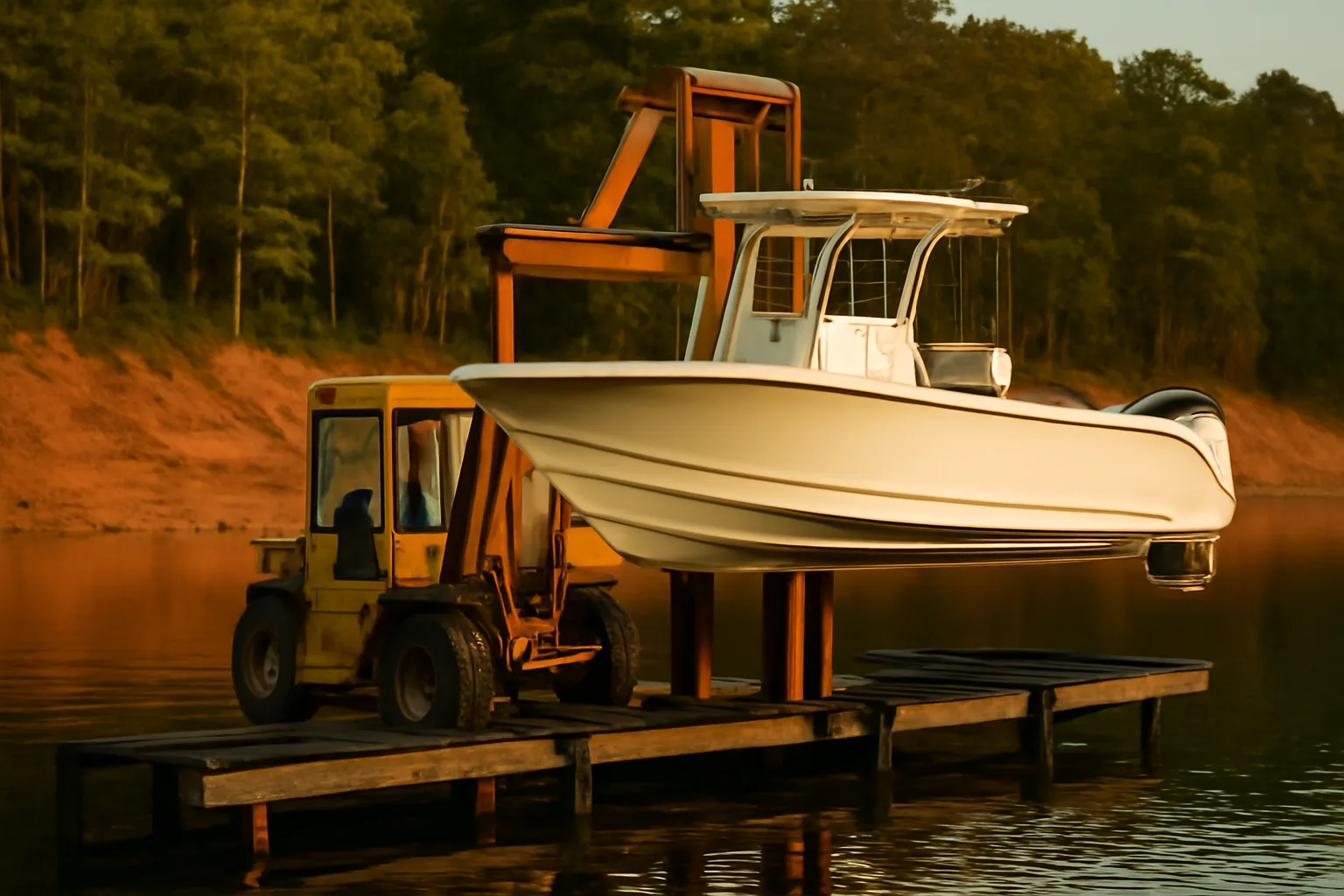
The machine that makes dry stack work is a marine forklift (or a travel lift plus forklift, on some yards). Specialized marina trucks are capital equipment, not a warehouse rider you pick up used on a whim. OSHA still treats them as powered industrial trucks. [6] Budget training, a written traffic plan inside the rack aisle, and a maintenance contract.
If you want a simple way to pressure-test slip count against insurance and truck capacity, DryStackPath publishes a $199 one-time Forklift + Insurance + Slip-Math Kit at /start. The rest of this page stands without it.
Launch wells, sheet pile, and dredging are where coastal and lake projects blow up. Get soundings. Get a geotech. I have a low opinion of we will figure the well out later. That sentence has wrecked more Georgia marina budgets than steel ever did.
What first-year operating costs hit a Georgia dry stack?
Year one is payroll, workers comp (if you hit the headcount trigger), marina operators liability, property and flood insurance, electricity for the building and the well, property tax or lease payments, software, and the parts that forklifts eat. It is not a light year.
Georgia workers compensation generally does not apply to a private employer that has regularly in service fewer than three employees in the same business in this state. [9] Cross three people and you are in the system. A weekend yard with two owners and no staff is a different file than a seven-day launch crew.
Insurance is not optional if a lender or a Corps outgrant is involved. Marina operators legal liability, hull on any work boats, and flood if you are in a Special Flood Hazard Area all show up. Premiums are local and loss-history driven. I will not invent a rate.
Utilities surprise people. Tall metal buildings on summer Georgia lakes get hot. You will spend money to keep staff standing near the well. Budget it.
Lease math on a project lake is its own line. ER 1130-2-406 is about shoreline allocation and exclusive use, not about doing you a favor on rent. [5] Confirm the current outgrant terms with the project office. Do not copy a rent number from a marina two lakes over.
What taxes, entity filings, and sales tax rules apply?
File the entity with the Secretary of State, then register with the Department of Revenue if you have taxable sales. [1] Georgia's state sales tax rate is 4 percent under O.C.G.A. § 48-8-30, and local governments add their own percentages. [8]
I will not tell you that every dry stack rental contract is taxable or is not. Storage, launch, labor, parts, and boat sales are different questions. Get a written answer from DOR or a Georgia tax CPA before you print a rate on a rate sheet. Guessing from a Florida blog is how you fund an audit.
Annual registration with SOS stays on the calendar. [2] Occupation tax stays local. [3] Ad valorem property tax is county-appraised. If you are a tenant on federal land, ask the project office what you pay and what you do not. Do not assume a Corps outgrant kills local tax. Ask.
Payroll accounts (withholding, unemployment) show up the week you hire. That is ordinary Georgia employer paper, not marina paper. Still do it on time.
What insurance and workers comp does Georgia expect?
Georgia expects you to follow the workers compensation statute once you regularly have three employees. [9] Below that threshold, the chapter often does not apply to a private firm, but a contract, a lease, or a lender can still force coverage. Read the outgrant.
OSHA still applies to the forklift regardless of headcount. [6] Training records matter after the first close call. Inspectors do not care that you only launch on Saturdays.
There is no Georgia marina insurance license. Carriers that understand rack collapse, launch well drownings, and customer boat damage are a short list. Get a broker who has actually placed marina operators legal liability, not a personal-lines shop that will discover racks in month eleven.
Flood is a separate decision. If the community participates in the NFIP and your building sits in the mapped floodplain, the building official and your lender will make the choice for you. Building above the required elevation is cheaper than arguing about it after a spring pool rise.
What would I spend money on first, and what is a waste?
I would spend the first checks on a boundary and topographic survey, a floodplain determination, a conversation with the zoning official, and a written read from either Coastal Resources or the USACE lake manager. That packet tells you whether the rest of the money has a home.
A waste of money: custom architectural renderings before zoning, a forklift deposit before the launch well is permitted, and any national binder that pretends Georgia paper is the same as dry stack marina cost in California. Also a waste: paying a consultant to expedite a Corps commercial outgrant that the project office is not offering.
I like used marine forklifts only when a competent mechanic has seen the mast and the tires. Cheap trucks destroy boats. That is how yards close.
Hold a small legal retainer for the entity, the lease, and the first agency letter. Skip the glossy market study that restates boat-registration chatter you can already read. Demand at your ramp is a traffic count, not a vibe.
How does Georgia stack up against nearby states?
Georgia is cheaper than coastal California on land, and it is not Florida. Florida has a deeper marina bar and a different environmental stack. Read dry stack marina cost in Florida if that is your other site. Alabama is the closest operational cousin on the inland reservoirs, with its own Corps districts. See dry stack marina cost in Alabama.
Arkansas and Illinois operators fight similar inland-lake lease logic, not Georgia marsh committees. If you are shopping paper styles, skim dry stack marina cost in Arkansas and dry stack marina cost in Illinois. Delaware's coastal file is a different animal (dry stack marina cost in Delaware).
None of those pages replace a Georgia county pre-app meeting. Copying a Florida stormwater SWPPP onto a Hall County rack building is how you buy a rewrite.
Where do people get the Georgia paper wrong?
They treat occupation tax as the marina license. They skip floodplain. They assume CMPA applies on Lanier, or that Lanier rules apply on the Satilla. They dredge a well and then call the Corps. They hire three people and ignore workers comp. [9]
They also underwrite demand with statewide boat chatter instead of ramp counts at that lake. Empty racks still happen when the drive time is wrong.
Last check before you wire a land deposit: name the waterbody, name the landowner, and name the three agencies that can stop the well. If you cannot do that on one page, you are not ready to bid steel.
DryStackPath is an independent publisher, not a law firm and not a service company. Confirm every fee, quota, and clock with the board that collects the money.
Frequently asked questions
Do you need a license for dry stack marina in Georgia?
No single statewide dry stack license exists. You form an entity with the Secretary of State, pay local occupation tax if the city or county levies it, and then collect zoning, building, EPD, and either CMPA or USACE paper. OSHA still covers the forklift. Confirm each office. Do not treat a city occupational tax certificate as permission to build in the water.
How much does dry stack marina cost in Georgia?
Plan on a multi-million dollar project once land or a lake lease, the rack building, a marine forklift, and first-year payroll are in. Georgia LLC articles are $100 and annual registration is $50 at the Secretary of State. Those filings are not the budget. Nobody publishes a clean statewide per-slip average you can take to a lender.
How long does dry stack marina take in Georgia?
Entity filing can finish in days. A clean upland building permit on already-zoned land can take a few months. Marsh permits, USACE individual permits, and new commercial outgrants on project lakes can run more than a year, and some lake slots are not open. There is no honest guaranteed clock. Confirm with the district or Coastal Resources.
Does Georgia have a marina operator license?
No. Georgia does not sell a marina operator card that replaces zoning, CMPA, EPD stormwater, or a Corps outgrant. You still need ordinary employer accounts if you have staff, and you still need local occupation tax where levied. Anyone selling a package Georgia marina license is describing another state.
Do I need a CMPA permit on Lake Lanier?
No. The Coastal Marshlands Protection Act applies to marshlands in the estuarine area, not to an inland Corps reservoir. Lanier work runs through the Mobile District project office and shoreline rules under ER 1130-2-406. You may still need USACE regulatory review if you put structures in the water. Ask the lake office in writing.
Who permits a dry stack on the Georgia coast?
DNR Coastal Resources and the Coastal Marshlands Protection Committee handle structures on or over marshlands. USACE still has Section 10 and 404 when waters of the United States are involved. EPD handles 401 certification and stormwater. The county handles zoning and the building permit. Coastal files often travel together. Do not pick only one office.
How much is a Georgia LLC for a marina?
The Secretary of State publishes $100 to file articles of organization for a domestic LLC, plus a published $50 annual registration. You also pay a registered agent and whatever local occupation tax applies. Confirm the live fee table before you file. Those amounts do not include legal drafting or tax setup.
When does workers comp start in Georgia?
O.C.G.A. § 34-9-2 generally keeps the workers compensation chapter off a private employer that has regularly in service fewer than three employees in the same business in this state. Hit three and you are typically in. A lease, lender, or Corps outgrant can still require a policy below that line. Read the contract.
Is dry stack storage taxable in Georgia?
The state sales tax rate is 4 percent, plus local add-ons, but that does not automatically mean every rack rental is taxable. Storage, launch labor, parts, and boat sales are different DOR questions. Get a written answer from the Department of Revenue or a Georgia tax CPA before you print tax on a rate sheet.
Do I need USACE approval for an upland-only rack?
A rack building sitting entirely on upland, with no fill, piles, or well in jurisdictional water, may stay with the county building official and EPD stormwater. The moment you cut a launch well, add piles, or work below the ordinary high water mark, Section 10 and 33 CFR Part 322 show up. Have the district confirm the ordinary high water line.
What stormwater permit does a Georgia marina need?
Land disturbance of one acre or more usually means EPD construction stormwater coverage during the build. Operating yards that wash equipment or maintain vehicles often need to ask EPD about the industrial stormwater general permit. Coverage depends on your activities and NAICS, not on the word marina. Confirm with EPD before you assume you are exempt.
Can I open a dry stack on a Corps lake if no lease is posted?
Often no. Commercial use on a project lake is an outgrant and shoreline allocation question, not a walk-up building permit. Inventory can be closed. ER 1130-2-406 is the policy backbone. Call the project office and ask what commercial instruments, if any, are actually available on that pool before you bid land next door.
Do I need a survey before I bid steel?
Yes. I would not bid a rack building or a launch well without a boundary and topographic survey and a floodplain determination. Georgia counties will not fix your finished floor after the metal is on a truck. A survey is cheap next to a well that misses deep water or sits in the floodway.
What fire and forklift rules apply inside the racks?
Local fire officials and the state Fire Marshal work from adopted codes. Marina and boatyard fire practice is commonly framed around NFPA 303, but the enforceable document is whatever Georgia and the county have adopted. OSHA 29 CFR 1910.178 still governs powered industrial trucks. Train operators and keep the aisle plan on paper.
Sources
- Georgia Secretary of State, How-To Guide: Limited Liability Company (LLC): Georgia publishes a $100 filing fee for domestic LLC articles of organization
- Georgia Secretary of State, How-To Guide: Annual Registration: Georgia publishes a $50 annual registration fee for most entities
- O.C.G.A. § 48-13-6 (Justia unofficial code text): Georgia local governments are authorized to levy occupation taxes on businesses
- O.C.G.A. § 12-5-286 Coastal Marshlands Protection Act permit requirement: A permit from the committee is required before altering marshlands or locating a structure on or over marshlands in the estuarine area
- U.S. Army Corps of Engineers ER 1130-2-406 Shoreline Management at Civil Works Projects: USACE shoreline management and exclusive-use policy governs private and commercial shoreline use on civil works lakes
- OSHA 29 CFR 1910.178 Powered industrial trucks: Federal OSHA sets safety requirements for the design, maintenance, and use of fork trucks and other powered industrial trucks
- 33 U.S.C. § 403 Rivers and Harbors Act Section 10 (Cornell LII): Creating an unauthorized obstruction to the navigable capacity of waters of the United States is prohibited
- O.C.G.A. § 48-8-30 Georgia sales and use tax imposition: Georgia imposes state sales and use tax at the rate of 4 percent
- O.C.G.A. § 34-9-2 workers compensation applicability: The workers compensation chapter generally does not apply to a private employer with regularly in service fewer than three employees in the same business in Georgia
- USACE Mobile District, Lake Sidney Lanier Shoreline Management: Lake Sidney Lanier has a project-specific shoreline management program for private and related shoreline use
- 33 CFR Part 322 Permits for Structures or Work in or Affecting Navigable Waters of the United States: USACE Part 322 regulations govern permits for structures and work in navigable waters of the United States