Last updated 2026-08-17
TL;DR
Alabama has no single "dry stack marina board." You'll work with ADEM for coastal and water permits, the Alabama State Port Authority if you're near state-managed waters, and your county for zoning and building. Licensing costs range from a few hundred to tens of thousands of dollars depending on facility size and location. Plan 6 to 18 months for the full permit stack.
What government body actually oversees dry stack marinas in Alabama?
No single "Dry Stack Marina Board of Alabama" exists. Clear that up first, because people search for it expecting a one-stop shop and then waste weeks looking for a door that isn't there.
What you actually have is a set of overlapping agencies, and which ones matter depends on where your facility sits. ADEM, the Alabama Department of Environmental Management, is the lead agency for any construction or operation touching wetlands, tidal waters, or navigable waterways [1]. If your site is on the Mobile Bay coast or any tidal zone, ADEM's Water Division issues the Section 401 water quality certification and coordinates with the U.S. Army Corps of Engineers for the federal Section 404/10 permit [2].
The Alabama State Port Authority (ASPA) controls specific port and waterway areas around Mobile and may require a separate operating agreement or lease if your facility is near state-managed berths [3]. Away from tidal water, on inland lakes and rivers, the Alabama Department of Conservation and Natural Resources (ADCNR) is your counterpart for any access or operational licenses tied to public water [4].
Then there's the local layer. Your county commission or municipality handles zoning, land use, and the building permits for the actual storage structure. For most dry stack operations, that building permit is where most of the construction inspection burden lands. Some counties, particularly Baldwin and Mobile, have additional stormwater and impervious surface rules that add another review cycle.
The practical answer: you're filing with two to four agencies at once, not one board.
Do you need a license for a dry stack marina in Alabama?
Yes, but "license" is the wrong word for most of what you need. Alabama doesn't issue a single "dry stack marina operating license" the way some states license restaurants or contractors.
What you actually need is a collection of authorizations:
1. ADEM Water Quality Certification (Section 401) if construction or operation affects state waters [1]. 2. U.S. Army Corps of Engineers Permit (Section 404 or Section 10, or both) for any work in or near navigable waters or wetlands [2]. 3. County Zoning Approval and a Building Permit for the storage structure itself. 4. If you're fueling, an ADEM Underground Storage Tank or Aboveground Storage Tank registration depending on your fuel system configuration [5]. 5. A business license from your municipality or county, which is a general requirement for operating any business in Alabama, not specific to marinas.
Some dry stack operations that are entirely upland (no work in state waters, no dredging, no dock construction) skip the ADEM and Corps permits entirely. That's common for smaller inland facilities that use an existing boat ramp and store boats in a warehouse. If you're in that situation, the county building permit and business license may be your full licensing stack.
Add a dock, do any dredging, or build any structure over water, and the federal and state water permits become mandatory. The Corps alone can take 60 to 120 days for a standard nationwide permit, and much longer for individual permits on complex sites [2].
For a short look at how Alabama's regulatory structure compares with neighboring states, the dry stack marina board in Georgia article covers Georgia's parallel DNR-plus-local structure, and the dry stack marina board in Florida guide is useful because Florida's more mature dry stack market has well-documented permitting paths that Alabama operators often benchmark against.
How much does a dry stack marina cost to permit and build in Alabama?
Permitting costs alone are hard to pin down because they scale with facility size, site complexity, and whether you trigger federal review. Here's an honest breakdown.
ADEM application fees for water quality certifications are set by rule and vary by project type. As of the most recent publicly available ADEM fee schedule, individual permit applications for water-related activities have ranged from several hundred dollars to several thousand dollars depending on the size and type of discharge or impact [1]. Confirm current fees directly with ADEM's Water Division before budgeting, because fee schedules update and this article can't guarantee a current figure.
The Corps of Engineers charges no fee for most standard permits under nationwide permit authority, but an individual permit review can carry a $100 processing fee and, more importantly, the cost of the environmental documentation you have to prepare, which can run $10,000 to $75,000 or more for a consultant-prepared environmental impact assessment on a complex site [2].
Building permits for the storage structure are set by each county. Most Alabama counties use a valuation-based fee structure. On a $2 million steel storage building, expect building permit fees in the range of $5,000 to $20,000, but this varies materially by county. Confirm with your specific county building department.
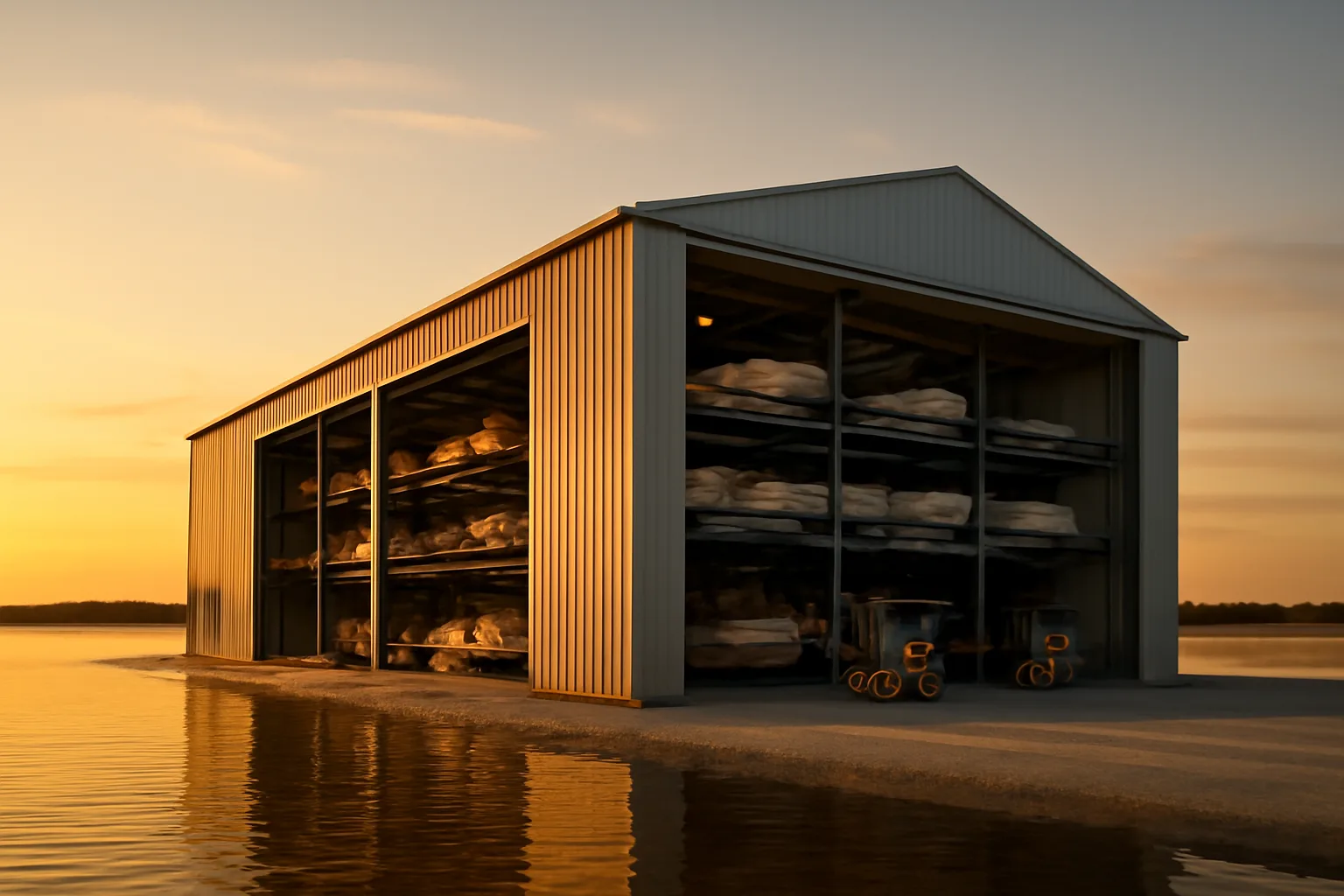
Now, the bigger number: construction itself. A bare-steel dry stack storage structure with forklift aisles and no amenities runs roughly $40 to $80 per square foot for the building shell in current Alabama markets (this is a range based on general commercial steel construction cost data, not a firm quote; get local contractor bids). A 200-boat facility storing boats averaging 25 feet needs roughly 60,000 to 80,000 square feet of covered space. At $60 per square foot that's $3.6 to $4.8 million just for the building. Add land, utilities, dock improvements, forklifts, and office space, and a mid-size dry stack marina in Alabama starts around $5 to $10 million in total capital for a new build.
| Cost Category | Low Estimate | High Estimate | Notes |
|---|---|---|---|
| ADEM water permit fees | $500 | $5,000+ | Confirm with ADEM; scales with project type |
| Corps of Engineers permit | $0 (NWP) | $100+ (IP) | Environmental docs can cost $10K-$75K extra |
| County building permit | $2,000 | $20,000+ | Valuation-based; confirm with county |
| Environmental consultant | $5,000 | $75,000 | Required for complex/individual permit sites |
| Storage structure (shell only) | $40/sq ft | $80/sq ft | Current Alabama steel construction range |
| Forklift(s) | $80,000 | $250,000 each | New; used units vary widely |
Pre-planning your slip math and forklift sizing before you file anything saves real money. DryStackPath's Forklift + Insurance + Slip-Math Kit at /start ($199 one-time) covers the capacity and equipment sizing math that drives your building footprint decision, which is worth doing before you hire a structural engineer.
How long does the dry stack marina permitting process take in Alabama?
Realistic range: 6 months on the absolute low end (small inland facility, no water impacts, cooperative county) to 18 to 24 months for a coastal facility requiring both ADEM certification and an Army Corps individual permit.
Here's where time actually goes.
ADEM Section 401 water quality certifications have a statutory processing window. Under the EPA's revised 2023 Section 401 certification rule, states must act within one year of receiving a complete application [6]. In practice ADEM often acts faster on straightforward projects, but do not assume speed. Public notice and comment periods are built into the process and add weeks.
The Army Corps of Engineers nationwide permits (NWPs) are the faster federal track. A standard NWP 9 (structures in navigable waters) or NWP 43 (stormwater management) review can take 45 to 60 days from a complete submission, assuming no resource agency objections [2]. An individual permit, which the Corps requires when impacts exceed NWP thresholds or when there's significant public interest, routinely takes 12 to 18 months or longer.
County review timelines differ sharply. Baldwin County and Mobile County both have active planning departments with published review schedules. Smaller inland counties may review faster simply because they see fewer projects. Zoning variances or conditional use approvals, which dry stack facilities often need because they're an unusual use in most zoning categories, add a public hearing cycle that can take 60 to 120 additional days.
The agencies don't coordinate their clocks for you. ADEM's review and the Corps review run on separate tracks. The county won't issue a building permit until you have your water permits in hand. So the critical path is almost always the water permitting track, and you should start those applications before you've finalized your building design.
Filing incomplete applications is the single biggest cause of timeline blowout. ADEM's completeness review alone can add 30 to 60 days if your initial submission is missing required attachments.
Which ADEM permits apply to a dry stack marina in Alabama?
The main ADEM touchpoints for a dry stack marina are the Section 401 Water Quality Certification, the National Pollution Discharge Elimination System (NPDES) permit if you have any stormwater or wastewater discharge, and, for fuel operations, the Aboveground Storage Tank (AST) or Underground Storage Tank (UST) program [1][5].
Section 401 is triggered by the federal nexus: any time the Army Corps or another federal agency is issuing a permit, Alabama has the right to certify (or deny) that the project meets state water quality standards. ADEM administers that review. The Alabama Water Quality Act, codified at Alabama Code Title 22, Chapter 22, is the foundational state authority [7].
NPDES permits apply if your facility discharges to state waters. A dry stack facility with a paved lot and stormwater runoff into a nearby waterway needs either an individual NPDES permit or coverage under ADEM's general permit for construction activities (if you disturb more than one acre) and potentially an industrial stormwater general permit for ongoing operations [1].
Fuel storage triggers ADEM's Underground Storage Tank program (for underground tanks) or the Aboveground Storage Tank regulations under Alabama Code Title 22, Chapter 35 (for above-grade fuel storage) [11]. This is a separate registration and inspection track from the water permits.
ADEM's permitting portal is at adem.alabama.gov. Applications go through their online system for most permit types. Confirm current fee schedules and required attachments directly with ADEM before filing, because required documentation lists have changed in recent years.
Does the Army Corps of Engineers review Alabama dry stack marina projects?
Yes, and this is often the longest part of the permitting timeline for coastal facilities.
The Corps' Mobile District covers all of Alabama [2]. Any work in, over, or adjacent to navigable waters of the United States, or in wetlands that are adjacent to those waters, requires a Corps permit under Section 10 of the Rivers and Harbors Act (for navigable waters) and Section 404 of the Clean Water Act (for fill into waters and wetlands).
A dry stack facility that has no dock, no dredging, and no fill into wetlands can often avoid Corps jurisdiction entirely. If your boats launch from a pre-existing public ramp and your storage structure is upland, you may have no Corps nexus. That's worth confirming in a pre-application meeting with the Mobile District before you spend money on environmental consultants.
For facilities that do trigger Corps review, nationwide permits are faster than individual permits. The Corps Mobile District's website lists which NWPs are available and their acreage and linear-foot thresholds [2]. Exceeding those thresholds means an individual permit, which adds significant time and documentation requirements including, in many cases, alternatives analysis and mitigation planning.
The Corps pre-application meeting process is genuinely useful and free. Regulators will tell you whether your project is likely to qualify for a nationwide permit or will need individual review. Request one early.
What county-level approvals does an Alabama dry stack marina need?
This is where "it depends on where you are" really matters.
Baldwin County and Mobile County are the two primary coastal Alabama counties where most waterfront dry stack projects occur. Both have county planning and zoning departments with published land development regulations. Dry stack storage facilities typically fall under commercial or light industrial zoning categories, and many parcels near water are not pre-zoned for that use. A conditional use permit or rezoning application is common, and both add public hearing requirements and 60 to 120 days minimum to your timeline.
For inland facilities on Lake Guntersville, Weiss Lake, or other ADCNR-managed lakes, you're typically in a rural county with less complex zoning, but you still need a building permit for the storage structure and may need a separate access agreement with ADCNR for any lake-adjacent improvements [4].
Building permits in Alabama are governed at the local level. Alabama has no statewide building code enforcement body for commercial structures the way some states do. Each county or municipality administers the adopted building code (Alabama has adopted the International Building Code with state amendments) independently. Inspections for a large steel storage structure will include structural, electrical, and fire suppression reviews at minimum.
If you're looking at how neighboring states handle the local approval layer, the dry stack marina board in Georgia and dry stack marina board in Florida articles describe similar county-plus-state structures that Alabama operators often compare to their own experience.
What are the zoning and land use rules for dry stack marina storage buildings in Alabama?
Alabama has no statewide marina-specific zoning category. Local zoning ordinances govern, and the definitions vary by jurisdiction.
In most Alabama counties, a dry stack storage building for boats is treated as either a commercial storage facility or a marine-related industrial use. Neither category is automatically permitted in waterfront zones, which are often residential or conservation-heavy. You may need a conditional use permit, a special exception, or in some cases a full rezoning before you can build.
Baldwin County's Zoning Ordinance, for example, lists marine-related commercial uses as a conditional use in certain zoning districts near the water. A conditional use application requires a public hearing before the Board of Zoning Adjustment, written notification to adjacent property owners, and a finding that the use meets specific criteria. Confirm current Baldwin County requirements directly with their planning department, as zoning ordinances are amended periodically.
Floodplain compliance is a parallel requirement for most waterfront sites. The National Flood Insurance Program (NFIP) requires that substantial improvements to structures in Special Flood Hazard Areas meet the base flood elevation requirements of your local floodplain ordinance [8]. A dry stack building near the water is almost certainly in a mapped SFHA. Your county floodplain administrator (usually in the building department) is the contact for this.
Fire code compliance for a building storing large quantities of boats with fuel in their tanks is a real concern that gets underestimated. Your local fire marshal will have requirements for aisle widths, sprinkler systems, and possibly fuel-in-boat storage limits. Engage the fire marshal early.
What does ADCNR regulate for inland dry stack marinas in Alabama?
The Alabama Department of Conservation and Natural Resources manages public waters, fish and wildlife, and state parks [4]. For dry stack marina operators, ADCNR matters primarily if your facility involves access to a public lake or river managed by the state.
ADCNR's State Lands Division manages submerged lands under navigable waters. If any part of your facility, such as a dock, floating launch ramp, or any structure, sits on state-owned submerged lands, you need a permit or lease from State Lands. This is a separate track from ADEM and the Corps.
ADCNR's Marine Police enforce boating safety regulations on Alabama waters. A dry stack marina operating a commercial launch service (where staff operate customer boats on the water) needs to be aware of boating safety certificate requirements for commercial operators under Alabama Code Title 33, Chapter 5 [9].
For facilities on TVA-managed lakes (Lake Guntersville, Wheeler, Wilson, Pickwick), the Tennessee Valley Authority has its own permitting requirements for shoreline development and docks [10]. TVA jurisdiction adds another agency to the stack for those locations.
What insurance requirements apply to Alabama dry stack marinas?
Alabama doesn't set minimum insurance limits for dry stack marina operators by statute the way some states do for specific industries. But your exposure is real and specific.
Commercial general liability is standard. Marinas storing customer boats have bailee liability (liability for damage to customer property in your care, custody, or control), which standard CGL policies typically exclude. You need a specific marina operators legal liability (MOLL) endorsement or a separate bailee policy.
If you're fueling, pollution liability is not optional. A fuel spill into Alabama waters triggers ADEM enforcement and potential EPA involvement. Standard CGL policies exclude pollution. A marina-specific pollution liability policy covers sudden and accidental spills from your fuel system.
Forklift operations create workers' compensation exposure and, if your forklift operators ever drop a boat, significant property damage liability. Forklift-specific endorsements or inland marine coverage for the boats in your care are worth reviewing with a marine insurance broker.
Property insurance for the storage building should account for named windstorm in coastal Alabama counties, where standard commercial property policies often exclude or sub-limit hurricane damage. Baldwin and Mobile counties have the wind exposure. Confirm your policy's named storm terms.
Nobody has a single authoritative source for Alabama marina insurance minimums because there isn't one. Talk to a marine-specialized broker, not a general commercial broker, because the MOLL and pollution coverages are specialized products.
How does Alabama compare to neighboring states for dry stack marina permitting?
Alabama sits in the middle of the regional complexity spectrum. Florida is the most complex, with a dedicated FDEP permitting track, Sovereignty Submerged Lands authorization, and detailed marina siting criteria that have accumulated over decades see the [dry stack marina board in Florida article]. Georgia is somewhat simpler on the state side but has active coastal marshlands protection that adds review time. Arkansas has a much lighter coastal permitting burden because it's landlocked, though its inland lake and river regulation still applies see [dry stack marina board in Arkansas].
Alabama's main advantage over Florida is that it doesn't carry Florida's level of anti-marina public opposition built into the regulatory process. Alabama's main disadvantage is that ADEM's guidance documents for marina-specific permitting are less developed than Florida's, so applicants get less clarity on what's expected before they file.
The Corps Mobile District has decades of experience with Alabama waterfront projects and is generally considered approachable for pre-application meetings. That's a real practical advantage compared to some other districts.
| State | Primary State Agency | Federal Nexus | Typical Coastal Timeline |
|---|---|---|---|
| Alabama | ADEM | Corps Mobile District | 6-18 months |
| Florida | FDEP + WMDs | Corps Jacksonville District | 12-36 months |
| Georgia | GA EPD | Corps Savannah District | 8-20 months |
| Arkansas | ADEQ | Corps Little Rock District | 4-12 months |
These timeline ranges are general estimates based on publicly documented permit processing information and should not be treated as guarantees.
Where do you actually start the Alabama dry stack marina approval process?
Start with a pre-application meeting, not a permit application.
Request a pre-application meeting with the Army Corps of Engineers Mobile District regulatory office before you spend money on engineering or environmental consultants [2]. Bring your site map, a description of what you want to build, and any preliminary drawings. The Corps will tell you whether you're likely to need a nationwide permit or an individual permit, and whether there are wetland or navigable water issues you haven't identified. This meeting is free and can save you months of rework.
At the same time, schedule a meeting with ADEM's Water Division to understand their 401 certification requirements for your specific project type. ADEM's office in Montgomery handles statewide permitting; their contact information is at adem.alabama.gov.
Parallel to the agency pre-application meetings, go to your county planning department and ask directly: what zoning district is my parcel in, is a dry stack marina a permitted or conditional use, and what's the process for approval? Do not assume from the zoning map; ask a planner.
After those three conversations, you'll know your actual regulatory stack and can sequence your applications correctly. Filing in the wrong order (county building permit before state water permit, for example) creates delays when one agency's approval hangs on another's.
For the internal planning work you do before those meetings, sizing your forklift capacity and slip count correctly matters because it drives your building footprint, which drives your site plan, which drives everything else. DryStackPath's Slip-Math and Forklift Kit at /start is a practical starting point for that pre-meeting planning work.
Frequently asked questions
Do you need a license for a dry stack marina in Alabama?
There's no single "dry stack marina license" in Alabama. You need a collection of authorizations depending on your site: ADEM water permits if you affect state waters, an Army Corps permit if you work in or near navigable waters or wetlands, county zoning approval, a building permit for your storage structure, and a general business license. Inland upland-only facilities often need only county and local business approvals.
How much does it cost to permit a dry stack marina in Alabama?
State permitting fees through ADEM range from a few hundred to several thousand dollars depending on project type. Confirm current fees with ADEM directly. Environmental consulting for complex Corps permit applications can cost $10,000 to $75,000. County building permits scale with construction value and vary by county. Total capital for a new mid-size dry stack facility, including land and construction, typically runs $5 to $10 million or more.
How long does dry stack marina permitting take in Alabama?
Plan for 6 months minimum on a small inland facility with no water impacts and a cooperative county. Coastal facilities requiring ADEM Section 401 certification and an Army Corps individual permit routinely take 12 to 24 months. Incomplete applications and county zoning hearings are the most common causes of timeline extension. Filing the Corps pre-application meeting request before you finalize your design is the best way to protect your schedule.
What is ADEM's role in Alabama marina permitting?
ADEM is the Alabama Department of Environmental Management and is the lead state agency for water quality permitting. They issue Section 401 water quality certifications for projects that also require federal Army Corps permits, administer NPDES stormwater and wastewater discharge permits, and regulate fuel storage through the UST and AST programs. Their Water Division handles most marina-related applications.
Does the Army Corps of Engineers regulate Alabama dry stack marinas?
Yes, for any work in or adjacent to navigable waters or wetlands. The Corps Mobile District covers all of Alabama. Construction of docks, dredging, or any fill into wetlands requires a Corps permit under Section 10 of the Rivers and Harbors Act or Section 404 of the Clean Water Act. Purely upland facilities with no dock work may not trigger Corps jurisdiction. A free pre-application meeting with the Mobile District can confirm your situation.
What county permits does an Alabama dry stack marina need?
At minimum: a zoning approval or conditional use permit (dry stack storage often doesn't fit existing zoning categories near water), and a building permit for the storage structure. Coastal counties like Baldwin and Mobile have additional stormwater and land development review requirements. Floodplain compliance is also a local requirement administered by your county building department. Timeline for county approvals, including any public hearings, is typically 60 to 180 days.
Do I need a TVA permit for a dry stack marina in North Alabama?
Yes, if your facility is on a TVA-managed reservoir such as Lake Guntersville, Wheeler, Wilson, or Pickwick. TVA regulates shoreline development and structures on TVA-managed lakes through their Shoreline Management Initiative. Any dock, ramp, or structure placed on TVA-controlled shoreline requires TVA approval, which is separate from ADEM and Corps permits. Contact TVA's regional office for your specific lake.
What insurance does an Alabama dry stack marina operator need?
At minimum: commercial general liability with a marina operators legal liability (MOLL) endorsement to cover customer boats in your care, pollution liability if you have fuel operations (standard CGL excludes pollution), workers' compensation for forklift and dock staff, and commercial property insurance. Coastal facilities need named windstorm coverage because standard policies often exclude hurricane damage in Baldwin and Mobile counties. Use a marine-specialized broker.
Can I operate a dry stack marina on an Alabama public lake without an ADCNR permit?
Not if any part of your operation involves structures on state-owned submerged lands. ADCNR's State Lands Division manages submerged lands under navigable state waters. Docks, ramps, or other structures on those lands require a permit or lease from State Lands. Operating a commercial launch service using public waters also implicates ADCNR's Marine Police for boating safety compliance.
Is a dry stack marina classified as a commercial or industrial use under Alabama zoning?
It varies by county. Most Alabama counties treat dry stack boat storage as either commercial storage or marine-related industrial use. Neither is automatically permitted in waterfront zones, which are often residential or conservation-designated. In Baldwin County, marine commercial uses typically require a conditional use permit with a public hearing. Confirm the specific classification for your parcel with your county planning department before investing in site design.
What's the difference between a nationwide permit and an individual permit from the Army Corps?
Nationwide permits (NWPs) are pre-authorized permit categories for smaller, lower-impact projects. If your project fits within an NWP's acreage and impact thresholds, review takes 45 to 60 days. An individual permit is required for larger or more complex projects, involves a full public interest review, and typically takes 12 to 18 months or more. The Corps Mobile District pre-application meeting will tell you which track your project requires.
How does Alabama dry stack marina permitting compare to Florida?
Florida is significantly more complex. Florida has a dedicated FDEP permitting track, Sovereignty Submerged Lands authorization through DEP, and water management district review. Alabama's ADEM plus Corps plus local structure is similar in concept but with less regulatory density and, generally, less organized public opposition to marina development. Alabama coastal timelines of 6 to 18 months compare favorably to Florida's typical 12 to 36 months for coastal marina permits.
What is the Alabama Water Quality Act and does it apply to dry stack marinas?
The Alabama Water Quality Act is codified at Alabama Code Title 22, Chapter 22, and gives ADEM authority to protect state waters from pollution and regulate activities that affect water quality. It applies to dry stack marinas that discharge stormwater to state waters, build structures affecting water quality, or conduct fueling operations. ADEM's Section 401 certification authority flows directly from this statute combined with the federal Clean Water Act.
Sources
- Alabama Department of Environmental Management, Water Division Permitting: ADEM Water Division administers Section 401 certifications, NPDES permits, and related water quality authorizations for Alabama projects
- U.S. Army Corps of Engineers, Mobile District, Regulatory Program: Corps Mobile District issues Section 404 and Section 10 permits for work in navigable waters and wetlands in Alabama; nationwide permit processing typically 45-60 days
- Alabama State Port Authority: Alabama State Port Authority controls port and waterway operations in the Mobile area and may require operating agreements for adjacent marine facilities
- Alabama Department of Conservation and Natural Resources: ADCNR State Lands Division manages state-owned submerged lands under navigable waters and issues permits or leases for structures on those lands
- Alabama Department of Environmental Management: ADEM administers the Underground Storage Tank registration and compliance program for fuel storage at Alabama facilities including marinas
- U.S. EPA, Clean Water Act Section 401 Certification: Under the 2023 EPA Section 401 rule, states must act on certification requests within one year of receiving a complete application
- Alabama Legislature, Alabama Water Quality Act, Code of Alabama Title 22 Chapter 22: Alabama Water Quality Act, Title 22 Chapter 22, provides ADEM's foundational authority over state water quality and permitting
- FEMA, National Flood Insurance Program, Floodplain Management Requirements: NFIP requires substantial improvements to structures in Special Flood Hazard Areas to meet base flood elevation requirements administered by local floodplain ordinances
- Alabama Legislature, Code of Alabama Title 33 Chapter 5, Regulation of Vessels: Alabama Code Title 33 Chapter 5 governs boating safety regulations applicable to commercial vessel operation on Alabama waters
- Tennessee Valley Authority, Shoreline Management Initiative: TVA regulates shoreline development and structures on TVA-managed reservoirs in Alabama including Guntersville, Wheeler, Wilson, and Pickwick lakes
- Alabama Legislature, Code of Alabama Title 22 Chapter 35, Aboveground Storage Tanks: Alabama Code Title 22 Chapter 35 governs aboveground storage tank regulation administered by ADEM for fuel storage facilities