Last updated 2026-08-17
TL;DR
A dry stack marina in Alabama typically costs $1.5 million to $8 million to build, depending on capacity and land. You need a state business license, a USACE Section 10/404 permit for any waterway work, and Alabama DNR approval. Permitting alone can take 6 to 18 months. No single state-issued 'dry stack license' exists; you're assembling several permits.
What does a dry stack marina actually cost in Alabama?
The honest answer is a wide range, and anyone quoting you a tight figure without seeing your site is guessing. Real project data and construction cost indices still give us numbers you can build a budget on.
Land is the wildest variable. Waterfront acreage on Mobile Bay or along the Intracoastal Waterway in Baldwin County can run $150,000 to $500,000 per acre depending on direct water access, road frontage, and whether the parcel already has bulkheads or rip-rap [1]. A 150-slip dry stack building typically needs 2 to 4 acres of upland, plus whatever travelift or forklift corridor and launch ramp area you're adding.
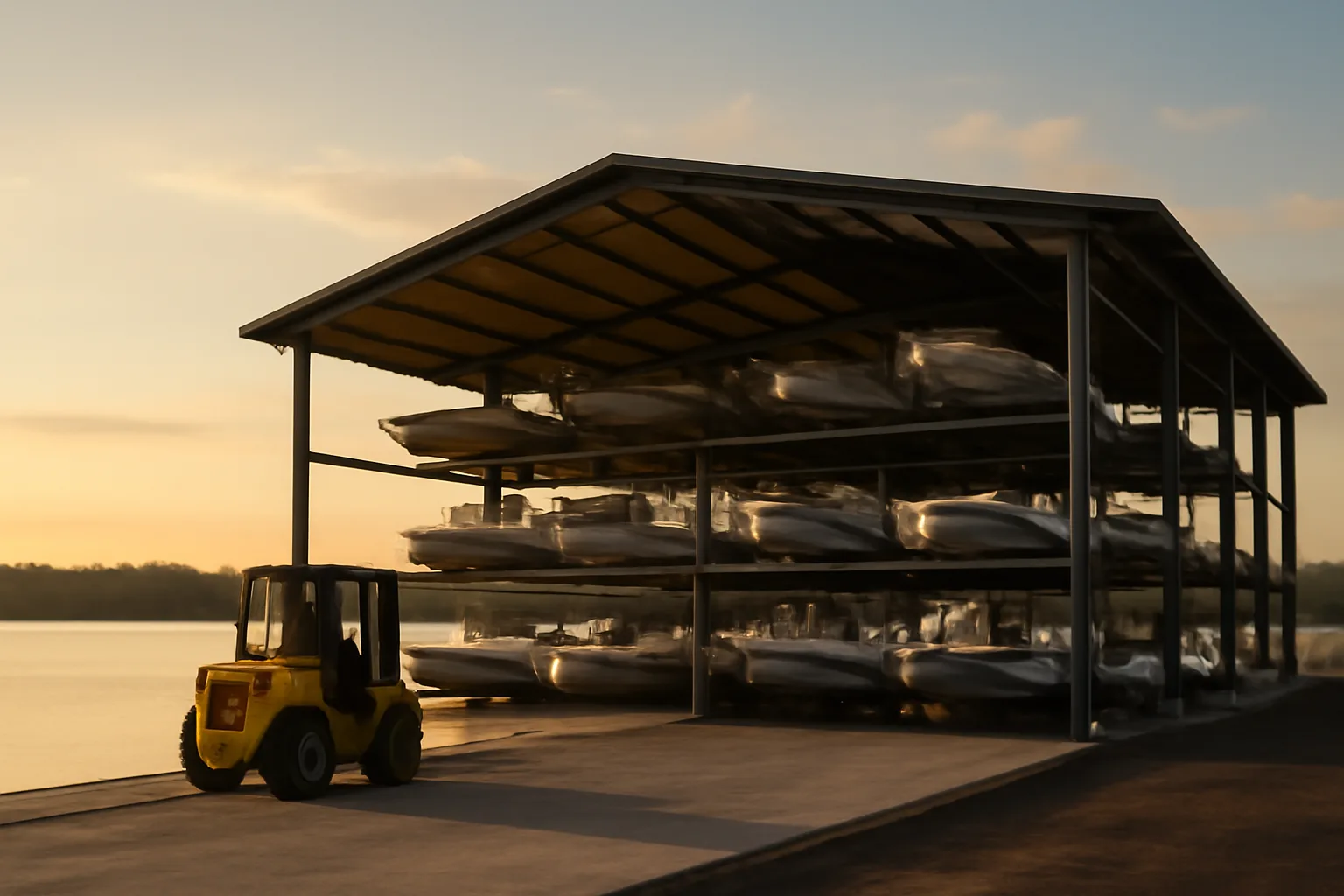
The building itself, a purpose-built open-sided storage structure with concrete piers and steel framing, runs roughly $4,000 to $7,500 per boat slip for the structure alone [2]. A 200-slip facility at the midpoint of that range puts you at $1.15 million just for the building shell before mechanical, electrical, or the forklift.
Here's where Alabama gets specific. The vessels on Alabama coastal waters trend larger than inland lake markets, so you're often sizing for boats up to 35 feet. A new Wiggins or Liebherr marina forklift with a 30- to 40-ton capacity will cost $400,000 to $750,000 delivered [3]. Used machines in working condition are available in the $150,000 to $280,000 range but carry higher maintenance risk in year one.
Permit fees in Alabama are comparatively modest, covered in detail in the licensing section below. The soft costs around permitting (wetland delineation, NEPA review support, engineering drawings) routinely add $50,000 to $150,000 to a project budget before a single shovel moves.
Total first-year capital range for a new 150-to-250-slip dry stack marina in Alabama: $1.5 million on the extreme low end (existing structure, acquired cheaply, minimal waterway work) to $8 million or more for a ground-up bayfront facility with ramp, fuel dock, and full forklift complement.
Do you need a license for a dry stack marina in Alabama?
There is no single "dry stack marina license" issued by Alabama. What you actually need is a stack of approvals from different agencies, each covering a different slice of the operation. Missing any one of them creates real legal exposure.
Here's the list as it actually works in practice:
Alabama Business License (state level). Any marina operating in Alabama needs a state business privilege license. You file through the Alabama Department of Revenue. The base fee is relatively small (typically under $200/year for the state portion), but some counties layer on their own business license fees on top [4].
Local/county business license. Baldwin County and Mobile County both require separate local business licenses for commercial operations. Baldwin County, where most of Alabama's coastal dry stack activity is concentrated, has a license tax schedule tied to gross receipts. Confirm the current rate with the Baldwin County Revenue Commission before you budget.
U.S. Army Corps of Engineers Section 10 / Section 404 permit. This is the big one. Any construction, fill, or structure in navigable waters or adjacent wetlands requires a USACE permit under Section 10 of the Rivers and Harbors Act of 1899 and, if wetland fill is involved, Section 404 of the Clean Water Act [5]. The Mobile District handles all Alabama coastal and inland waterway projects. Standard individual permits take 6 to 18 months. Nationwide Permits (pre-approved categories for smaller impacts) may apply if your waterway impact is under the applicable acreage threshold, but a marina launch facility usually triggers individual permit review.
Alabama State Lands Division approval. If any portion of your project touches state-owned submerged lands (anything below mean high water on tidal waters), you need a lease or easement from the Alabama State Lands Division under the Alabama Department of Conservation and Natural Resources [6]. This is a separate process from the USACE permit and has its own timeline.
ADEM Water Quality Certification (Section 401). The Alabama Department of Environmental Management issues a 401 Water Quality Certification for any project that gets a federal permit and may affect state waters [7]. ADEM coordinates with USACE so this often runs parallel rather than sequential, but it can independently delay or condition your project.
Zoning and local land use approvals. Baldwin County's Zoning and Planning Commission controls commercial waterfront land use along the coast. Marine commercial zoning is not automatic. If the parcel isn't already zoned for marina use, a rezoning or conditional use permit adds 3 to 9 months and real political risk to your schedule.
The Alabama Marine Police also inspects operating marinas for safety compliance, including fuel handling, fire suppression, and life safety equipment, but this is a compliance program rather than an upfront license. Still, you want to build to their standards from day one.
Bottom line: budget for at least four to six separate approval processes, each with its own application, fee, and timeline.
How long does getting permitted take in Alabama?
Plan for 12 to 24 months from first application to construction start on a new coastal facility. That range reflects real Alabama project experience in the Mobile Bay corridor, not a national average.
The USACE Mobile District individual permit process is the long pole. The Corps' own guidance describes a standard review target of 60 days for simple cases and up to one year for complex ones, but projects with wetland impacts, public objections, or coordination requirements with USFWS or NOAA routinely run 12 to 18 months [5]. The Mobile District has historically carried a full workload given Gulf Coast activity.
ADEM 401 certification runs concurrently but can independently extend the clock if water quality concerns need resolution.
Alabama State Lands Division lease processing is the least predictable piece. The division reviews projects for consistency with state submerged land policies, and negotiating lease terms (area, duration, annual fee) can add several months.
Local zoning and county approvals can theoretically move faster, 3 to 6 months if the parcel is already correctly zoned, but a rezoning hearing cycle in Baldwin County realistically adds 6 to 12 months on top of that.
Pre-application meetings help. The USACE Mobile District offers pre-application meetings for complex projects, and using one before you file reduces the chance of a major revision request mid-review [5]. Schedule that meeting before you spend money on full engineering drawings.
If your site has minimal wetland impact and you can qualify for a Nationwide Permit rather than an individual permit, the Corps timeline compresses hard, sometimes to 45 to 75 days after your notification is submitted. Whether you qualify is a site-specific determination.
What are the main cost categories for a dry stack marina in Alabama?
Breaking costs into real buckets helps you stress-test a pro forma.
| Cost Category | Typical Range (Alabama) | Notes |
|---|---|---|
| Land acquisition | $300K to $2M+ | Bayfront vs. inland canal varies enormously |
| Site prep / bulkhead / ramp | $100K to $600K | Existing ramp saves significant money |
| Storage building (per slip) | $4,000 to $7,500 | Steel frame, open sides, concrete piers |
| Forklift (new) | $400K to $750K | 30-40 ton capacity; new Wiggins-class |
| Forklift (used) | $150K to $280K | Higher maintenance risk |
| Permit fees (all agencies) | $10K to $40K | Hard fees only, not soft costs |
| Permitting soft costs | $50K to $150K | Engineers, wetland consultants, attorneys |
| Office / utilities / signage | $50K to $200K | Highly variable |
| First-year working capital | $100K to $300K | Payroll, insurance, fuel inventory |
Insurance gets underestimated in Alabama specifically because of hurricane exposure. A 200-slip coastal Alabama facility should budget $80,000 to $150,000+ annually for property and liability combined. Gulf Coast wind and named-storm coverage has become materially more expensive since 2020, and several major underwriters have pulled back appetite for Alabama coastal commercial marine risks [8]. Get quotes before you finalize your pro forma. Do not use a national marina insurance average.
Fuel infrastructure is optional but changes the math. Adding an in-water fuel dock with underground storage tanks adds $200,000 to $500,000 in capital but opens a revenue stream with decent margins. Alabama has Underground Storage Tank (UST) program requirements administered by ADEM that add regulatory compliance costs [7].
How does Alabama compare to neighboring states on dry stack permitting complexity?
Alabama sits in the middle of the Gulf Coast pack. It's less complex than Florida, which layers an additional state environmental resource permit from FDEP on top of the federal process, creating what amounts to a parallel full review. See how Florida's costs and permitting stack up
Alabama is broadly comparable to Georgia in complexity. Georgia has state shoreline permitting through the Coastal Resources Division that mirrors Alabama's State Lands process, though Georgia's DNR has somewhat faster published processing targets. Georgia's dry stack marina cost breakdown is here.
Arkansas is landlocked but has significant lake-based dry stack activity, with no tidal permitting layer and simpler Army Corps coordination. Dry stack marina costs in Arkansas are typically lower for land and permitting, though the market demand is also much thinner.
On construction costs, Alabama has a regional labor cost advantage over California or Connecticut. ENR's construction cost index shows Gulf Coast markets running 8 to 15% below coastal Northeast and Pacific markets [2]. That helps. Land cost differences between a Baldwin County bayfront parcel and an inland lake lot can easily dwarf any labor savings.
The honest takeaway: Alabama is a reasonable place to build a dry stack marina compared to most coastal states. The permitting is real but manageable. Hurricane exposure is the factor that changes the economics most compared to inland states.
What does first-year operation actually cost in Alabama?
Year one is always the hardest on cash. You're carrying full fixed costs before your slip occupancy ramps up, and in a new market you should plan for 12 to 24 months to reach 80% occupancy.
Payroll is typically the largest operating line. A 200-slip operation needs at minimum two licensed forklift operators, a dock hand or two, and an office manager. Alabama minimum wage follows the federal floor of $7.25/hour [9], but skilled marina forklift operators in coastal Alabama earn $18 to $28/hour depending on license and experience. Budget $250,000 to $450,000 in total annual labor cost for a mid-size facility.
Forklift maintenance on a new machine in year one is lower, but plan for $15,000 to $30,000 annually as a normalized expense. Tires alone on a large marina forklift cost $3,000 to $8,000 each and may need replacement every 1,500 to 2,500 operating hours depending on ramp surface conditions.
Alabama has no state income tax on individuals (which helps when recruiting operators) but does have a corporate income tax at 6.5% on net income above $6,000 [10]. Property taxes on commercial waterfront property in Baldwin County vary by parcel assessment but should be modeled explicitly. Waterfront commercial assessments are not cheap.
Slip fee revenue in coastal Alabama: in-water slips in the Mobile Bay area range from $8 to $18 per foot per month. Dry stack fees for covered storage tend to run $12 to $22 per foot per month depending on boat size, access hours, and concierge launch services. These are market-observed ranges, not published rate schedules, so verify with comparable local operators before using them in a pro forma.
What Alabama-specific regulations affect day-to-day dry stack operations?
A few regulations have real operational bite that surprises first-year owners.
Alabama Marine Police, under the Alabama Law Enforcement Agency, patrols both coastal and inland waters and conducts marina compliance inspections. Their focus is life jackets, fire extinguishers, and fuel handling safety at commercial facilities. The relevant authority is the Alabama Boating Safety Act [11]. Violations can result in operating restrictions, so run your facility to NFPA 303 standards ("Fire Protection Standard for Marinas and Boatyards") from day one even though Alabama doesn't independently mandate it by name.
Alabama's oil spill response requirements affect any marina that handles fuel. Facilities over a certain fuel storage threshold must have a Spill Prevention, Control, and Countermeasure (SPCC) plan under EPA regulations [12]. Even if you're below the threshold, document it.
Water quality discharge: any stormwater runoff from your facility that reaches navigable water must comply with ADEM's NPDES stormwater program. A marina with a paved lot and boat washing area is almost certainly a regulated facility [7]. The permit is not expensive but the compliance paperwork is ongoing.
Boat registration in Alabama runs through the Alabama Law Enforcement Agency. Your customers need current registration for any boat stored with you. This isn't your obligation to police, but knowing the rules helps you answer customer questions and avoids confusion at launch.
How do you structure the paper path before you spend money?
This is the part most new entrants get wrong. They spend money on land or a building quote before confirming the permit path is achievable. Then they discover the site has a wetland delineation problem or is in a USACE high-priority review area and the whole project stalls.
Do these four things in order before you commit capital:
First, get a wetland delineation by a licensed wetland scientist. This tells you what you're actually dealing with on the parcel. It costs $3,000 to $8,000 and can save you from buying an unpermittable site.
Second, schedule a pre-application meeting with the USACE Mobile District. It's free, and it tells you whether you're looking at an individual permit or Nationwide Permit pathway and what studies you'll need.
Third, contact the Alabama State Lands Division to confirm whether your proposed footprint touches state submerged lands and get a preliminary read on lease feasibility.
Fourth, check local zoning with Baldwin County or Mobile County planning before signing anything.
If all four come back workable, you have a permittable site. Then you spend money on engineering.
DryStackPath publishes a Forklift + Insurance + Slip-Math Kit at /start that walks through the equipment sizing and insurance structure logic once you've confirmed site feasibility. It's not a substitute for the pre-application meeting, but it helps you show up to that meeting with realistic numbers.
What does slip pricing look like in Alabama and how does it affect payback?
Payback period on a dry stack marina is almost entirely a function of two numbers: what you charge per slip per month and where your occupancy stabilizes.
Alabama's coastal market clusters around Mobile Bay, the Intracoastal Waterway in Baldwin County, and the Tennessee River lakes in the north (Wheeler, Guntersville, Pickwick). Coastal and river markets behave differently.
On Mobile Bay and the Gulf Coast, dry stack monthly rates for a covered slip on a 22-to-26-foot boat run about $200 to $400 per month depending on amenities and launch convenience. Boats in the 30-to-35-foot range push toward $400 to $600/month in premium facilities. These are observed market rates from recent operating years. They are not guaranteed and vary by location.
On the Tennessee River lakes (Wheeler, Guntersville), the market is more price-sensitive. Dry stack rates for similar boats run $150 to $300/month, and the population of large boats is smaller. Construction costs are also lower because you're not building to hurricane exposure standards, which changes the economics.
A 200-slip coastal facility at 85% occupancy charging $300/month average generates $612,000/year in storage revenue before fuel, launch fees, or ancillary services. With total operating costs (labor, insurance, maintenance, property tax) running $400,000 to $600,000/year, the operating margin before debt service is real but thin at lower price points. This is why getting the slip pricing right before you commit to a capital structure matters as much as permitting.
For a deeper look at how Alabama compares to a high-cost coastal state, the dry stack marina cost in California guide shows a different set of tradeoffs on the same math.
What are the biggest cost mistakes Alabama dry stack developers make?
A few patterns show up over and over in projects that run over budget or stall.
Underestimating insurance. Gulf Coast wind insurance on a commercial structure has genuinely become harder to obtain since Hurricane Sally (2020) and Ida (2021). Some operators have seen renewal quotes 40 to 60% higher than their initial year. Build in annual escalation of 10 to 20% for the first three years when you model insurance costs [8].
Skipping the geotechnical report. Coastal Alabama has soft bay-bottom soils in many locations. A building that works fine on a sandy upland lot needs very different foundation engineering on a filled or marginal site. The geotech report costs $5,000 to $15,000. Discovering foundation problems after you've poured concrete costs far more.
Buying the wrong forklift. Size a marina forklift for the largest boat you'll realistically take in, not for your current average fleet. Buying a 20-ton machine and then turning away 35-foot center consoles because they exceed your rated capacity is a real revenue leak. The forklift choice drives your marketing positioning.
Miscounting soft costs in the permit budget. The actual permit application fees (USACE, ADEM, State Lands, local) add up to $10,000 to $40,000 in hard fees. But the engineering drawings, wetland studies, cultural resource surveys (USACE often requires them under Section 106 of the National Historic Preservation Act), and attorney time to respond to agency questions add another $50,000 to $150,000 that first-time applicants consistently underestimate.
Not modeling the launch ramp bottleneck. A single forklift on a busy Friday afternoon is the operational chokepoint in a dry stack marina. If your ramp geometry or forklift count can't service demand peaks, customers leave. Ramp width, turning radius, and travel distance from the storage building to the water need to be engineered together, not tacked on late.
Where to get current Alabama fee and permit information
Fees and processing times change. The figures in this article reflect published rates and observed timelines as of the date of publication, but confirm every number with the relevant agency before you budget.
USACE Mobile District: the Mobile District permit section handles all Alabama waterway project applications. Their permit application form is ENG Form 4345 [5].
Alabama ADEM: administers Section 401 Water Quality Certification and the NPDES stormwater program. ADEM's Land Division handles UST compliance for fuel facilities [7].
Alabama State Lands Division (under ADCNR): handles submerged land leases and easements [6].
Alabama Department of Revenue: business privilege license applications and the state tax structure [4].
Baldwin County Revenue Commission: local business license fees and property tax assessment for Baldwin County parcels.
For equipment budgeting and slip-math modeling once your permit path is confirmed, the DryStackPath Forklift + Insurance + Slip-Math Kit at /start organizes those numbers in a format ready to take to a lender or investor. One purchase, no subscription.
If you're comparing Alabama to other Gulf or Southeast markets, the Georgia dry stack marina cost guide and Florida guide are the most directly comparable.
Frequently asked questions
Do you need a specific 'dry stack marina license' in Alabama?
No single dry stack marina license exists in Alabama. You need a state business privilege license from the Alabama Department of Revenue, a local county business license, a USACE Section 10/404 permit for any waterway construction, an Alabama State Lands Division lease if you touch state submerged lands, and ADEM Section 401 Water Quality Certification. That's typically four to six separate approvals.
How much does a dry stack marina cost to build in Alabama?
A new dry stack marina in Alabama costs roughly $1.5 million to $8 million depending on site, capacity, and whether land is already owned. The storage building runs $4,000 to $7,500 per slip for the structure. A new 30-to-40-ton marina forklift adds $400,000 to $750,000. Land on Mobile Bay or Baldwin County waterways can cost $150,000 to $500,000 per acre.
How long does it take to get a dry stack marina permitted in Alabama?
Plan 12 to 24 months from first application to construction start for a coastal Alabama facility. The USACE Mobile District individual permit is the longest step, often 12 to 18 months for projects with wetland impacts. If you qualify for a Nationwide Permit instead, the Corps review can compress to 45 to 75 days. Local zoning and State Lands lease add additional time running concurrently.
Does the USACE Mobile District handle Alabama marina permits?
Yes. The U.S. Army Corps of Engineers Mobile District handles all permit applications for structures or work in Alabama navigable waters and adjacent wetlands. You apply using ENG Form 4345. The Mobile District offers pre-application meetings for complex projects, which are worth scheduling before you spend money on full engineering drawings.
What is the Alabama State Lands Division and why does it matter for a marina?
The Alabama State Lands Division, part of the Department of Conservation and Natural Resources, manages state-owned submerged lands below mean high water on tidal waters. Any marina structure or ramp that extends below that line requires a lease or easement from the Division. This is a separate process from the USACE permit and has its own timeline and annual fee.
What does a marina forklift cost in Alabama, and what size do you need?
A new purpose-built marina forklift with 30- to 40-ton capacity costs $400,000 to $750,000 delivered in Alabama. Used machines in good condition run $150,000 to $280,000 but carry higher year-one maintenance risk. Size your machine for the largest vessel you plan to handle, more than your current average boat, or you'll turn away revenue.
How much does insurance cost for an Alabama dry stack marina?
Budget $80,000 to $150,000 or more annually for combined property and liability coverage at a 200-slip coastal Alabama facility. Gulf Coast wind and named-storm coverage has become significantly more expensive since 2020. Get actual quotes before finalizing your pro forma; national marina insurance averages will understate Alabama coastal exposure materially.
What are typical dry stack slip rates in coastal Alabama?
Monthly dry stack storage rates on Mobile Bay and the Gulf Coast range from about $200 to $400/month for boats in the 22-to-26-foot range and $400 to $600/month for 30-to-35-foot boats in premium facilities. Inland Tennessee River lake markets run lower, roughly $150 to $300/month, reflecting both lower construction costs and more price-sensitive demand.
Does Alabama have a stormwater permit requirement for marinas?
Yes. Alabama marinas with paved lots, boat washing areas, or other stormwater sources that discharge to navigable waters are regulated under ADEM's NPDES stormwater program. You need to obtain a stormwater permit and maintain compliance documentation. ADEM administers this program under Alabama's delegated authority from the EPA.
How does Alabama dry stack marina permitting compare to Florida?
Alabama is somewhat less complex than Florida. Florida requires an additional state Environmental Resource Permit from FDEP that runs in parallel with the federal USACE process, effectively creating two full environmental reviews. Alabama's state layer (ADEM 401 and State Lands) is real but generally faster than Florida's FDEP process. Construction costs in Alabama also tend to run lower than Florida's coastal markets.
What is Alabama's business privilege license fee for a marina?
The Alabama state business privilege license base fee is under $200 annually for the state portion, administered by the Alabama Department of Revenue. Counties add their own business license tax on top, often tied to gross receipts. Baldwin County, where most Alabama coastal dry stack activity is located, has its own fee schedule. Confirm current rates with the Baldwin County Revenue Commission.
Do you need a wetland delineation before applying for a marina permit in Alabama?
Yes, practically speaking. The USACE Mobile District needs to know whether your project impacts jurisdictional wetlands to determine whether you qualify for a Nationwide Permit or need an individual permit. A licensed wetland scientist can conduct the delineation for $3,000 to $8,000. Skipping it and then discovering a wetland problem mid-application wastes far more time and money.
What operating costs should a first-year Alabama dry stack marina budget for?
Labor is typically $250,000 to $450,000 annually for a mid-size 200-slip facility, covering forklift operators, dock hands, and office staff. Add $80,000 to $150,000 for insurance, $15,000 to $30,000 for forklift maintenance, and property taxes on coastal commercial land. Total annual operating costs before debt service commonly run $400,000 to $600,000 for a facility of that size.
Can you convert an existing wet slip marina to dry stack in Alabama?
Yes, and it often shortens the permit timeline because you're modifying an existing permitted facility rather than creating a new one. Whether you can qualify for a less intensive permit pathway depends on the scope of change. Contact the USACE Mobile District for a pre-application meeting before assuming conversion is simpler. Existing ramps, bulkheads, and utility connections reduce capital costs significantly.
Sources
- Baldwin County Revenue Commission, Property Search: Waterfront commercial property values and assessment basis in Baldwin County, Alabama
- Engineering News-Record, Construction Cost Index: Gulf Coast construction labor cost differential versus Northeast and Pacific coastal markets, approximately 8 to 15% lower
- Alabama Department of Revenue, Business Privilege License: Alabama requires a state business privilege license for commercial operations; state base fee and filing process
- U.S. Army Corps of Engineers Mobile District, Regulatory Program: USACE Section 10/404 permit requirements for structures in Alabama navigable waters; individual permit review timelines; pre-application meeting availability; ENG Form 4345
- Alabama Department of Conservation and Natural Resources, State Lands Division: Alabama State Lands Division manages leases and easements for state-owned submerged lands below mean high water on tidal waters
- Alabama Department of Environmental Management, Water Division: ADEM administers Section 401 Water Quality Certification, NPDES stormwater permits, and Underground Storage Tank compliance for Alabama facilities
- U.S. Department of Labor, Wage and Hour Division, Minimum Wage by State: Alabama minimum wage follows the federal floor of $7.25 per hour
- U.S. EPA, Spill Prevention Control and Countermeasure Rule (40 CFR Part 112): Facilities above EPA threshold fuel storage volumes must maintain a written SPCC plan; applies to marinas handling fuel