Last updated 2026-08-17
TL;DR
A dry stack marina in Alabama needs a U.S. Army Corps of Engineers Section 10/404 permit, an ADEM Section 401 Water Quality Certification, county zoning and building approval, and a state business license. Budget 12 to 36 months for the permit stack, longer if you trigger an Environmental Impact Statement. A modest 150-boat facility runs $5 million to $10 million all-in.
What licenses and permits do you actually need to open a dry stack marina in Alabama?
Nobody hands you the full permit stack in one place. So here it is.
Alabama has no single "marina license" you apply for and receive. What you get instead is a layered pile of approvals from four or five agencies, each of which can independently kill your project. Miss one, and you're building without authorization.
Here's the core stack.
Federal permits. Any structure or fill in navigable waters or adjacent wetlands triggers the U.S. Army Corps of Engineers process under Section 10 of the Rivers and Harbors Act of 1899 and Section 404 of the Clean Water Act. The Mobile District handles every Alabama waterway permit [1]. A project that qualifies as a Nationwide Permit can clear in 45 to 90 days. Most dry stack sites don't qualify because of scale, so you're looking at an Individual Permit, which the Corps targets at 12 months and routinely takes longer.
State water quality certification. Under Section 401 of the Clean Water Act, Alabama issues its own Water Quality Certification through the Alabama Department of Environmental Management (ADEM) before the Corps can finalize your federal permit [2]. ADEM checks whether the project meets state water quality standards. This runs alongside the Corps review in theory. In practice, plan for it to add time.
ADEM coastal permits. If your site sits in coastal Alabama (Baldwin or Mobile counties), you also deal with ADEM's coastal permitting under the Alabama Coastal Area Act [3]. Baldwin and Mobile shorelines are where most viable dry stack sites exist, so this catches the majority of developers reading this.
County zoning and building permits. Dry stack buildings are large metal structures, often 50 to 80 feet tall with enclosed or semi-enclosed bays. You need county zoning approval (or a variance if you're in an agricultural or low-density residential zone), a building permit, and an environmental site plan. Baldwin and Mobile each run their own planning departments. Confirm which zoning class allows marine commercial use before you tie up money on a parcel.
State business license. Alabama requires a general business privilege license, and Baldwin and Mobile counties both layer local registration on top of the state requirement [4]. Check with the county probate judge's office for the local piece.
Fuel and spill rules. The Alabama Law Enforcement Agency Marine Police handle boating enforcement, and there's no separate ALEA operating license for the marina itself. But if you fuel boats, you'll meet EPA and ADEM requirements for aboveground storage tanks and petroleum spill prevention under the SPCC rule [5].
Our deeper breakdown at dry stack marina license in Alabama has the agency contact list and form numbers.
How long does it take to get a dry stack marina permitted and open in Alabama?
Plan for 12 to 36 months of permitting before you break ground. That range isn't sloppiness. It reflects real variability in site conditions, agency workload, and whether you trip an environmental impact statement.
Here's roughly how it sequences.
Months 1 to 3. Pre-application meetings with the Corps Mobile District and ADEM. These are worth every hour. The Corps will tell you whether your site has a reasonable path to an Individual Permit and flag endangered species or historic property issues that need extra studies. Don't skip this.
Months 3 to 9. Site assessment work. You commission a wetland delineation, a biological assessment (especially for Gulf sturgeon or sea turtle habitat in coastal waters), and often a cultural resources survey if the Corps asks for one. This phase costs real money before a single application goes in.
Months 6 to 18. Formal application and agency review. The Corps public notice period is 30 days. After that, agency coordination, state 401 certification, and responses to requests for more information can stretch this phase past 12 months on a complex project [1].
Months 12 to 24 or longer. If your project triggers a full Environmental Impact Statement because of significant impacts to navigable waters, wetlands, or listed species, add another 12 to 24 months. The Corps has EIS timelines under NEPA and regularly exceeds them.
After federal permits. County building permits, site plan approvals, and construction usually add 6 to 18 months, depending on your contractor and local inspection schedules.
The single biggest timeline killer in Alabama is wetland acreage. If your site has more than a fraction of an acre of jurisdictional wetlands, budget extra time and money for mitigation planning. The Corps Mobile District regulatory page lays out the steps [1].
For a look at a state with similarly heavy coastal permitting, how to start a dry stack marina in Florida covers the same problem with different agencies.
How much does it cost to start a dry stack marina in Alabama?
Costs vary so widely that any single number lies to you. Here are honest ranges by component you can actually price out.
Land. Waterfront or water-access property in Baldwin County (the dominant market, given its proximity to Mobile Bay and the Gulf) runs $500,000 to several million, depending on acreage, waterfront footage, and existing infrastructure. Mobile County sites can run lower but are more boxed in by industrial zoning.
Permitting and environmental work. Pre-application studies, wetland delineation, biological assessments, cultural resource surveys, and the application itself typically cost $50,000 to $200,000 for a complex coastal site. An EIS adds $200,000 to $500,000 or more in consulting fees plus a longer clock.
Site work and marine construction. Bulkheads, launch ramps, fuel docks, and channel dredging (if required) run $500,000 to $2 million depending on site conditions.
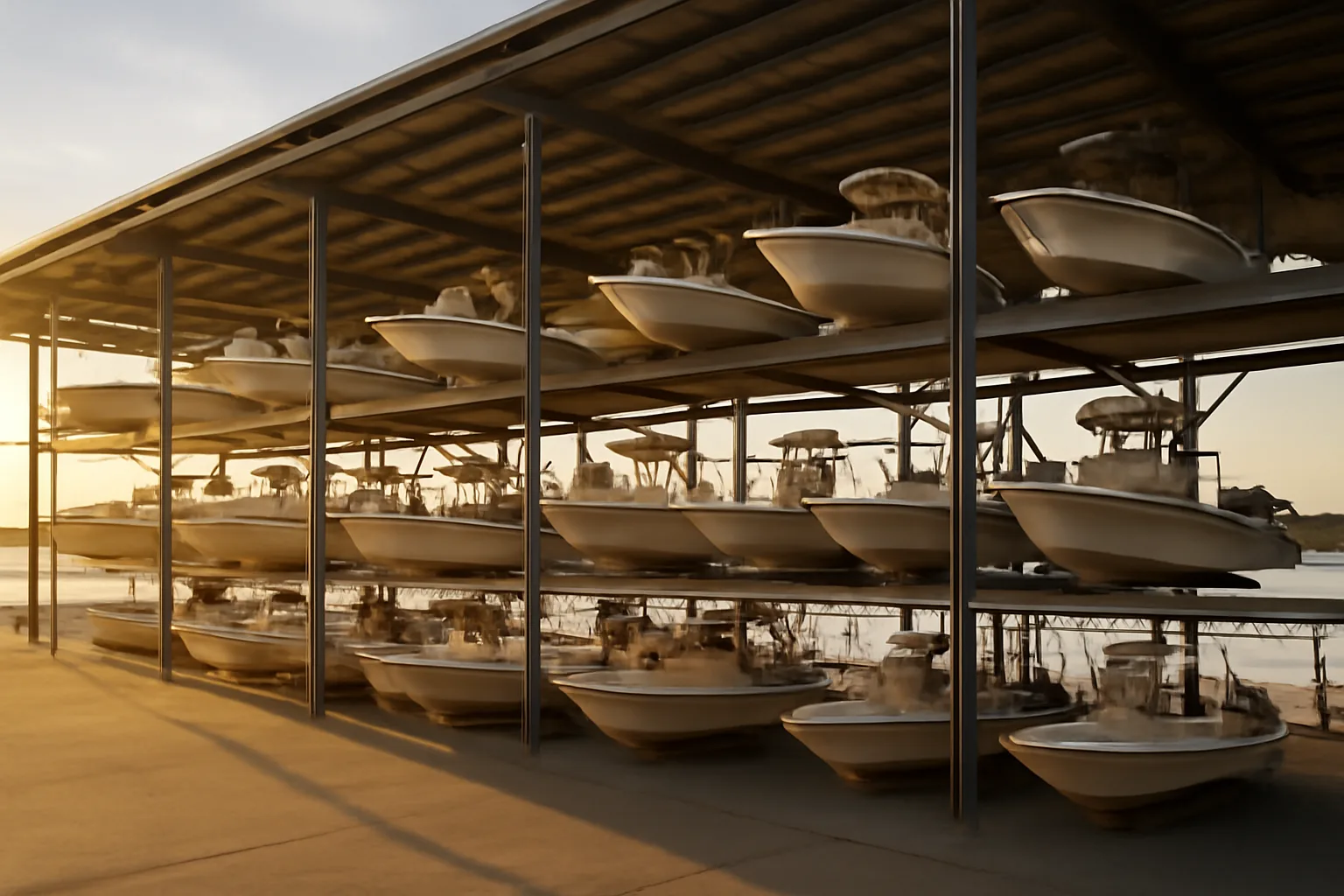
The storage building. Your largest single cost. A purpose-built rack holding 150 to 250 boats, with a forklift aisle and travel lane, runs roughly $2 million to $5 million installed. Structure type drives it: open-sided steel at the low end, full enclosure with fire suppression at the high end. Local steel prices and whether you pour a fresh slab or reuse one both move the number.
Forklift equipment. A new heavy-duty marina forklift (Wiggins, Taylor, or comparable) rated for boats in the 30,000-to-50,000-pound range costs $150,000 to $350,000 new. Budget for at least two machines above 150 slips, because one machine down means no operations.
Insurance. Commercial general liability, marine operator's liability, property, and pollution liability together run $50,000 to $150,000 a year for a mid-size facility. Premiums swing on carrier appetite, claims history, and how much fueling you do.
Working capital. Plan for 12 to 18 months of operating losses while you fill. Most dry stack marinas don't reach breakeven occupancy (roughly 70 to 80 percent of capacity) until year two or three.
A conservative all-in for a 150-boat Alabama dry stack marina, land through first-year reserves, is $5 million to $10 million. Larger facilities (300-plus boats) push well past $15 million.
The DryStackPath Forklift + Insurance + Slip-Math Kit ($199 one-time) packages the equipment sizing spreadsheet and insurance checklist if you're modeling these line items now.
What does the U.S. Army Corps of Engineers review in Alabama marina applications?
The Corps Mobile District is the federal gatekeeper for any work in, over, or next to Alabama's navigable waters. Their review is a public interest review: they weigh your project's benefits against its reasonably foreseeable impacts on navigation, fish and wildlife, water quality, energy, safety, and other factors set out in 33 CFR Part 320 [6]. The regulation directs the Corps to weigh "the probable impacts, including cumulative impacts, of the proposed activity and its intended use on the public interest."
For a dry stack marina, the Corps looks hardest at three things. Fill in wetlands or open water comes first, because every cubic yard requires avoidance, minimization, or compensatory mitigation (mitigation bank credits, or new wetlands created somewhere else). Navigation comes second, because your launch ramp, fuel dock, and boat traffic have to share the waterway with existing vessels. Water quality comes third, because marinas concentrate fuel, boat traffic, and antifouling paint in a tight area.
The Corps also coordinates your application with the U.S. Fish and Wildlife Service, the National Marine Fisheries Service (for coastal or estuarine habitat), the EPA, and the State Historic Preservation Office. Any of them can object, which extends your timeline and can force a redesign.
If your project qualifies for a Nationwide Permit, specifically NWP 9 (structures in navigable waters) or NWP 36 (boat ramps), the process is faster. But NWPs carry acreage limits and other thresholds [10]. The Corps verifies eligibility on request, and that pre-application talk is worth having early [1].
What does ADEM review, and how does the coastal permitting process work in Alabama?
ADEM runs two tracks for a dry stack developer. The first is the Section 401 Water Quality Certification, required before the Corps can issue your federal permit. ADEM checks whether the project will meet Alabama's water quality standards and can impose conditions (like limits on impervious surface draining into the waterway) that reshape your site design [2].
The second track, for coastal sites, is the Alabama Coastal Area Management Program, administered by ADEM's Land Division. The Alabama Coastal Area Act (Alabama Code Section 9-7-10 et seq.) requires a permit for construction or dredging in the coastal area of Baldwin and Mobile counties [3]. "Coastal area" reads broadly and includes tidal areas, bays, estuaries, and adjacent uplands, so most viable dry stack sites in south Alabama fall inside it.
ADEM reviews coastal permits case by case, looking at shoreline impacts, water quality, habitat, and consistency with the state coastal program. Processing times aren't published as fixed deadlines. ADEM has indicated reviews can run 90 to 180 days for complete applications, and complex projects with significant impacts take longer. Confirm current timelines directly with ADEM's Land Division in Montgomery.
One practical point. ADEM and the Corps accept joint applications through a coordinated process. File once, and both agencies work from the same document package, which saves time and cuts the risk of conflicting requests.
What zoning and local approvals does a dry stack marina need in Baldwin and Mobile counties?
Most Alabama dry stack development happens in Baldwin County, given access to Mobile Bay, the Intracoastal Waterway, and the Gulf, with Mobile County a distant second. Both counties run their own zoning codes and planning departments.
In Baldwin County, marina uses usually fall under commercial or marine commercial zoning. But the county's zoning map is a patchwork along the bay and coastal waterways, and plenty of parcels that look like good marina sites carry agricultural or low-density residential zoning. A rezoning or conditional use permit adds 3 to 9 months and a public hearing to your timeline.
Baldwin County also has an impact fee schedule for new construction that can add tens of thousands of dollars. Confirm the current schedule with the Baldwin County Planning and Zoning office directly.
Mobile County runs a separate planning commission and building department. Urban zones near the Port of Mobile tend to carry more permissive industrial or commercial classifications, but the industrial character of many Mobile waterfront sites makes them a poor fit for recreational marina use.
In both counties, your building permit for the storage structure triggers review against local building codes, including wind load. Alabama's coastal counties carry heavy hurricane exposure, and your structure must meet the wind speed design requirements in the Alabama State Building Code, which references ASCE 7 load standards. A 150-mile-per-hour design wind speed is not unusual for coastal Baldwin County. That single requirement drives a big cost gap between inland and coastal buildings.
What equipment do you need to operate a dry stack marina in Alabama?
The forklift is the heart of the operation, and getting its spec wrong is an expensive mistake. You're not buying a warehouse forklift. You're buying a purpose-built boat handler, usually from Wiggins, Taylor, or Pettibone, built to lift boats with lopsided weight, carry them across a concrete apron, and set them on a launch ramp without damage.
Alabama's market leans toward center consoles, bay boats, and offshore sport fishers in the 22-to-35-foot range. For that fleet, a forklift rated 15,000 to 35,000 pounds covers most boats. Plan to handle larger offshore boats (38-plus feet, twin outboards), and you need capacity near 50,000 pounds. Confirm what your target market actually keeps in the water and size to it.
The concrete apron matters as much as the machine. Manufacturers publish minimum slab thickness and PSI for their equipment. Skimping on the slab is one of the most common and most expensive operator mistakes, because a slab failure under load wrecks the machine and the boat both.
Beyond the forklift, you need a fueling system (if you sell fuel), pump-out facilities (required under EPA and ADEM rules for marinas that keep boats in the water, and worth having even for dry stack), and marina management software for tracking boats, scheduling launches, and billing storage.
The DryStackPath Forklift + Insurance + Slip-Math Kit covers equipment sizing, slab spec parameters, and a model insurance checklist for the Alabama market.
What insurance does an Alabama dry stack marina need?
Insurance for a dry stack marina in Alabama is not standard commercial property with a marina endorsement. You need specific marine policies, and the gap between a generic commercial policy and a proper marine one is wide enough to sink you financially.
At minimum, you need commercial general liability covering boat handling and premises liability, marine operator's legal liability (which specifically covers damage to customer vessels in your care, custody, and control), commercial property for the building and equipment, and pollution liability for fuel spills and releases.
In Baldwin County or any coastal flood zone, you also decide whether to carry flood coverage through the National Flood Insurance Program or a private flood carrier. NFIP commercial building coverage caps at $500,000 per building [7], well below the replacement value of most dry stack structures. Private flood fills the gap but costs a lot more.
Alabama law requires workers' compensation once you have five or more employees, and maritime employees (workers on or around navigable waters) may fall under the Longshore and Harbor Workers' Compensation Act, which adds a separate exposure [8]. Confirm with a marine insurance specialist, not a general commercial broker.
Premiums for a 150-boat Alabama dry stack marina with fueling typically run $50,000 to $150,000 a year in combined marine coverage. The range is wide because carrier appetite for coastal Alabama risk keeps shifting with storm exposure.
How do you structure the business entity for an Alabama dry stack marina?
Most Alabama marina operators use an LLC or a corporation (usually a C-corp or S-corp) rather than a sole proprietorship, for the obvious liability reason. Boat handling carries real physical risk. A customer boat damaged by a mishandled forklift, or a guest hurt on the premises, generates litigation. An LLC, kept clean with separate bank accounts and a formal operating agreement, puts a wall between business liability and your personal assets.
Alabama LLC formation goes through the Secretary of State and costs $200 as of recent filings, though you should confirm the current fee because the state has adjusted these periodically [4].
You also want a well-drafted storage agreement for every customer. Alabama courts enforce well-written limitation of liability clauses in commercial storage contracts, but boilerplate won't hold. Get a maritime attorney to draft your slip and storage agreement, specifically one who handles commercial boating and marina law, not a general real estate attorney.
Some operators split the real estate into one LLC that owns the land and building, run the marina through a second operating LLC, then lease from the first. That structure can give both liability compartmentalization and tax advantages, but it adds complexity. Talk to a CPA with marina or maritime experience before you choose.
What does it actually cost to get through the permitting phase in Alabama?
Most developers underestimate the soft costs of permitting by a factor of two or three. Here's where the money goes before you break ground.
| Permitting cost item | Typical range |
|---|---|
| Corps of Engineers permit application fee | $10 to $100 (federal fee is nominal; costs are in preparation) |
| Wetland delineation (field and report) | $5,000 to $25,000 |
| Biological assessment (species survey) | $10,000 to $40,000 |
| Cultural resources survey | $5,000 to $30,000 |
| Environmental consultant (permit prep and coordination) | $30,000 to $150,000 |
| Attorney fees (permit process and property) | $20,000 to $80,000 |
| ADEM coastal permit preparation | included above or $10,000 to $30,000 additional |
| Wetland mitigation bank credits (if required) | $20,000 to $500,000+ depending on acreage |
| County rezoning and variance (if needed) | $5,000 to $30,000 in consulting and legal, plus filing fees |
Total permitting soft costs before construction: $75,000 to $400,000 for a typical coastal Alabama site, with projects that trigger mitigation or an EIS pushing higher.
That's real money spent before you have a paying customer or a shovel in the ground. It's also non-recoverable if the project doesn't get permitted. That's why experienced marina developers spend heavily on pre-application meetings and environmental screening before committing to a site.
How do Alabama's dry stack marina rules compare to neighboring states?
Alabama sits in the middle of the Southeast for regulatory weight. It's less demanding than Florida, which layers its own coastal construction control line permitting on top of the federal process, but meaningfully heavier than inland states where you mostly face Corps permits and a business license.
Georgia, Mississippi, and Arkansas each present different trade-offs. Mississippi has fewer coastal sites but a lighter Corps district workload, which can mean faster processing. Georgia adds state-level review under its Coastal Marshlands Protection Act for coastal projects.
Alabama's edge for dry stack development is the concentration of boating demand on Mobile Bay and in coastal Baldwin County, paired with a relatively business-friendly state regulatory climate (outside the unavoidable federal and coastal overlay). The state doesn't hit marina operations with punitive business taxes, and the existing boating infrastructure (launch ramps, channel markers, fueling networks) means your customers already know the waterway.
For side-by-side comparisons, see how to start a dry stack marina in Arkansas and how to start a dry stack marina in Arizona, both states with meaningfully different permit stacks.
What should you do in your first 90 days of planning a dry stack marina in Alabama?
The first 90 days are about screening, not committing. You want to know whether your site has a reasonable path to permits before you spend on engineering and legal work.
Step one: take your candidate site to the Corps Mobile District for a pre-application meeting. It's free and informal. Staff will look at aerial imagery, identify obvious jurisdictional waters and wetlands, and tell you whether you're on a Nationwide Permit path or an Individual Permit path. One meeting can save you months and tens of thousands of dollars.
Step two: hire an environmental consultant with Corps Mobile District experience to run a preliminary wetland assessment. A formal delineation isn't needed yet, just enough to know whether you have a serious wetland problem.
Step three: pull the county zoning classification and flood zone map for the parcel. Check FEMA's Flood Map Service Center for the flood zone designation [9]. A Zone AE or VE designation in coastal Baldwin County affects your building footprint, elevation requirements, and insurance costs.
Step four: run the slip-math. How many boats fit in your footprint, with the forklift aisle clearances and drive lanes the manufacturer requires? That count, times your expected monthly storage rate, is your theoretical revenue ceiling. If the site can't hold enough boats to carry your debt, no permitting outcome makes the project work.
Step five: talk to a maritime attorney about ownership structure and your storage agreement before you go further. An hour of their time now beats finding a structural problem after you've signed a purchase agreement.
Frequently asked questions
Do you need a specific marina license to operate a dry stack marina in Alabama?
Alabama doesn't issue a single "marina license." You need a state business license, county business registration, and the relevant environmental permits (Corps of Engineers, ADEM Water Quality Certification, and a coastal area permit if you're in Baldwin or Mobile County). There's no separate marina operating license at the state level, but each permit layer is a real legal requirement. Missing any one exposes you to stop-work orders and fines.
How long does it take to permit a dry stack marina in Alabama?
Plan for 12 to 36 months of permitting alone, depending on site complexity. Simple sites with minimal wetland impacts and no endangered species issues move faster. Projects that require an Individual Corps Permit, ADEM coastal review, and wetland mitigation routinely take two to three years before construction can begin. Add 6 to 18 months of construction after that.
How much does it cost to build a dry stack marina in Alabama?
A 150-boat facility in coastal Alabama typically costs $5 million to $10 million all-in, including land, permitting, site work, the storage building, and forklift equipment. Larger facilities (300-plus boats) push well past $15 million. Permitting soft costs alone run $75,000 to $400,000 before construction starts, depending on environmental complexity and whether wetland mitigation is required.
Which Alabama counties are best for dry stack marina development?
Baldwin County is the dominant market, with access to Mobile Bay, the Gulf Intracoastal Waterway, and Gulf inlets. It holds the highest concentration of recreational boating demand in the state. Mobile County has waterfront land but is more constrained by industrial zoning near the Port of Mobile. Both counties require county zoning and building permits on top of state and federal approvals.
Do I need a wetland permit to build a dry stack marina in Alabama?
Almost certainly yes if your site has any coastal or riparian wetlands, which most viable marina sites do. Section 404 of the Clean Water Act requires a Corps of Engineers permit for fill in jurisdictional wetlands or waters. ADEM must also issue a Section 401 Water Quality Certification. If you trigger wetland fill beyond what Nationwide Permits allow, you'll need an Individual Permit and likely wetland mitigation.
What kind of forklift do dry stack marinas in Alabama use?
Purpose-built boat-handling forklifts from makers like Wiggins, Taylor, or Pettibone. For Alabama's typical market (22-to-35-foot center consoles and bay boats), a machine rated 15,000 to 35,000 pounds covers most boats. Offshore fishers and larger sportboats need 50,000-pound capacity. These are not warehouse forklifts. Slab thickness and concrete PSI specs from the manufacturer matter as much as machine capacity.
What insurance does an Alabama dry stack marina need?
At minimum: commercial general liability, marine operator's legal liability (for boats in your care, custody, and control), commercial property, and pollution liability for fuel operations. Coastal Baldwin County sites need flood coverage beyond NFIP's $500,000 building cap, usually through private flood markets. Workers' compensation is required at five-plus employees. Maritime worker exposure may also trigger Longshore Act coverage. Use a marine insurance specialist, not a general commercial broker.
Can I get a Nationwide Permit for a dry stack marina in Alabama?
Possibly, for limited components. NWP 9 covers certain structures in navigable waters and NWP 36 covers boat ramps. But most dry stack projects in Alabama exceed the acreage and impact thresholds for Nationwide Permits because of the scale of site work, fill, and infrastructure. The Corps Mobile District can confirm NWP eligibility in a pre-application meeting, which is the right first step.
What is the Alabama Coastal Area Act and does it affect my marina?
The Alabama Coastal Area Act (Alabama Code Section 9-7-10 et seq.) requires ADEM permits for construction, dredging, or filling in Alabama's coastal area, which covers tidal zones, bays, estuaries, and adjacent uplands in Baldwin and Mobile counties. Most dry stack sites in south Alabama fall inside the coastal area. ADEM's Land Division administers the program. Budget 90 to 180 days or more for review of complete applications.
Do I need a lawyer to start a dry stack marina in Alabama?
You need at least two: a maritime or environmental attorney who knows Corps and ADEM permitting, and a business attorney to set up your entity and draft your customer storage agreement. Alabama courts enforce limitation of liability clauses in commercial storage contracts, but only well-drafted ones. A general real estate attorney without marina experience is no substitute for someone who knows maritime law and Clean Water Act procedure.
How do I estimate how many boats my Alabama site can store?
Start with your usable building footprint in square feet. Subtract forklift aisle width (typically 18 to 24 feet depending on machine spec) and drive lane clearances. Remaining floor space divided by average boat slip width (typically 12 to 14 feet per bay) gives you a rough rack count. Multiply by three to four rack levels for standard racking systems. Confirm clearance heights and aisle dimensions with your specific forklift manufacturer's layout guidelines.
What are Alabama's wind load requirements for dry stack marina buildings?
Alabama's State Building Code references ASCE 7 load standards. In coastal Baldwin County, design wind speeds for structures often run 150 miles per hour or higher in the most exposed locations. That requirement sharply increases steel framing costs compared to inland Alabama. Your structural engineer sets the exact design wind speed for your site from the ASCE 7 wind speed map and local amendments. Don't let a building vendor quote you an inland spec for a coastal site.
Is a dry stack marina a good investment in Alabama?
The economics work in markets with strong recreational boating demand and limited covered storage supply, which describes parts of coastal Baldwin County. But the capital intensity is high ($5 million to $10 million for a modest facility) and the permitting timeline is long. Most facilities don't hit breakeven occupancy (70 to 80 percent of capacity) until year two or three. The margin profile is attractive once you're full, but the path to full takes longer than most first-time operators plan for.
Does Alabama have any state grants or financing programs for marina development?
Alabama's Department of Conservation and Natural Resources administers some boating access and infrastructure programs, and the Alabama State Port Authority occasionally has economic development programs relevant to coastal infrastructure. The USDA's Business and Industry loan guarantee program is worth investigating for rural coastal sites. Marina development typically doesn't qualify for most small business grant programs. Check with the Alabama Department of Commerce for current economic development incentives, which change regularly.
Sources
- U.S. Army Corps of Engineers, Mobile District, Regulatory Program: The Corps Mobile District handles all Section 10 and Section 404 permit applications for Alabama waterways; Individual Permits target 12-month processing but often take longer
- U.S. EPA, Section 401 Water Quality Certification: Section 401 of the Clean Water Act requires states to issue a Water Quality Certification before the Corps can finalize a federal permit for projects affecting navigable waters
- Alabama Code, Section 9-7-10 et seq., Alabama Coastal Area Act: The Alabama Coastal Area Act requires ADEM permits for construction or fill in Alabama's coastal area, covering tidal zones, bays, estuaries, and adjacent uplands in Baldwin and Mobile counties
- U.S. EPA, Spill Prevention, Control, and Countermeasure (SPCC) Rule, 40 CFR Part 112: Marinas with aboveground fuel storage meeting threshold volumes must comply with EPA SPCC requirements for petroleum spill prevention
- U.S. Army Corps of Engineers, 33 CFR Part 320, General Regulatory Policies: The Corps conducts a public interest review of permit applications weighing benefits against impacts on navigation, fish and wildlife, water quality, safety, and other enumerated factors
- FEMA, National Flood Insurance Program, Commercial Building Coverage Limits: NFIP commercial building coverage caps at $500,000 per building, which is below the replacement value of most dry stack storage structures
- U.S. Department of Labor, Longshore and Harbor Workers' Compensation Act: Maritime employees working on or near navigable waters may be covered under the Longshore and Harbor Workers' Compensation Act, creating additional employer obligations beyond state workers' compensation
- FEMA, Flood Map Service Center: FEMA's Flood Map Service Center provides flood zone designations (AE, VE, etc.) for specific parcels, which determine building elevation requirements and flood insurance obligations
- U.S. Army Corps of Engineers, Nationwide Permit 9, Structures in Navigable Waters: NWP 9 covers certain structures in navigable waters and NWP 36 covers boat ramps; both have acreage and impact thresholds that most full marina projects exceed, requiring Individual Permits instead