Last updated 2026-08-21
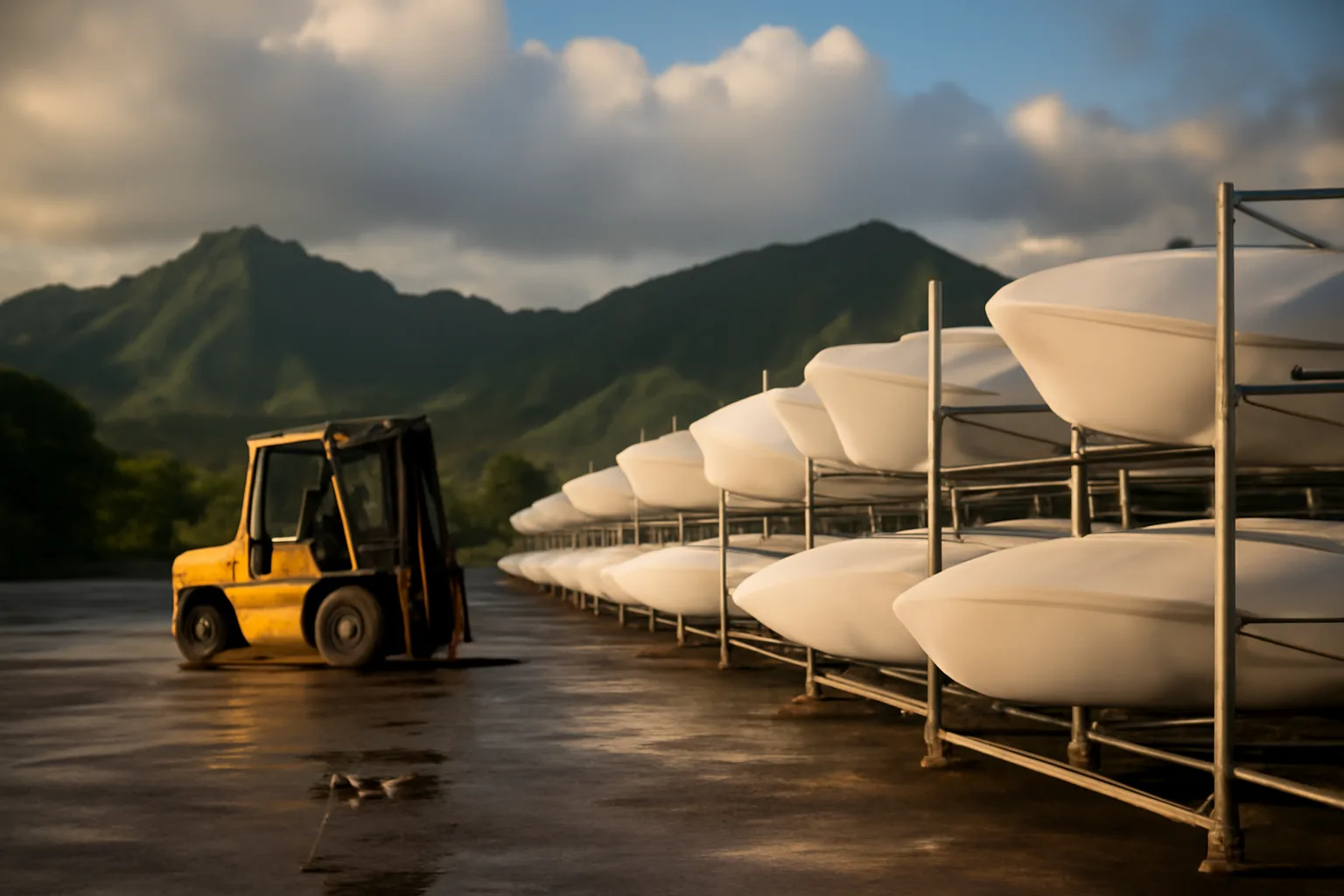
TL;DR
There is no one Hawaii dry stack marina license. You register the company, get a general excise tax license, then stack county zoning, a Special Management Area permit if you sit on the coast, building permits, and often Chapter 343 review plus a U.S. Army Corps permit if you touch the water. Fees and clocks are not one number. Confirm each item with the agency that issues it. Do not buy steel until the SMA path is real.
How do you start a dry stack marina in Hawaii?
You start by controlling land that can legally launch boats. Then you form a Hawaii entity, open a general excise tax account, and run a stacked permit path. Zoning, a coastal Special Management Area permit, building permits, and often Chapter 343 review sit in that pile. A U.S. Army Corps permit joins them if you touch the water. No single state card says dry stack marina.
I would not buy racks first. I would not hire a mainland marina architect first. Get a written zoning confirmation from the county planning department, then a real SMA strategy, then a civil package that fits height limits and a loaded forklift turning radius. Pretty waterfront is a trap if the forks cannot turn.
Site control should carry permit contingencies. If the SMA dies, you want out of the lease. Hawaii coastal land is scarce and neighbors show up. A dry stack is a tall industrial box with noise, lights, and wash water. Sell that honestly in the first meeting.
The sequence that wastes the least money looks like this. Confirm the parcel can host racks and a launch under the county land use ordinance. Map the SMA, the shoreline setback, and any conservation district line. Decide if Chapter 343 will trigger (it often will near the shore). Only then spend on structural steel drawings. Register the company and the GET license while design is in schematic, not the night before you take deposits.
Water access is the business. An inland warehouse with no lawful launch is self-storage. Customers still need a ramp or a well. Crossing a public road with a boat on forks is how you pick a fight with the county. Build the well or control the ramp, or do not call it a marina.
Want a side-by-side of another long coastal path? Read how to start a dry stack marina in California. California is not Hawaii. The habit of stacking land-use paper before steel is the same.
Do you need a license for dry stack marina in Hawaii?
No single Hawaii license carries the title dry stack marina. You still need a bundle of real paper. Almost every operator needs a Hawaii general excise tax license and a business registration with the Department of Commerce and Consumer Affairs. County development approvals are the hard part. A DOBOR use permit matters if you operate out of a state small boat harbor, not if you sit entirely on private upland with your own launch.
HRS 237-13 is the tax statute people skip. It reads, in part, "There is hereby levied and shall be assessed and collected annually privilege taxes against persons on account of their business and other activities in the State measured by the application of rates against values of products, gross proceeds of sales, or gross income." [1] Storage fees, launch fees, and most yard services fall in that world. Confirm the rate class with the Department of Taxation. Do not invent a GET story because a mainland CPA called it sales tax.
DCCA registration is how the entity exists. It is not permission to stack boats on the coast. [12] You still need the county to call the use lawful. You still need SMA if the work is development in the special management area. [5][13]
State small boat harbors sit under HRS Chapter 200. The department adopts rules for those facilities. [15] If your forklift never enters a DOBOR harbor, do not collect a harbor mooring permit you do not need. If you run shuttles or commercial activity from a state ramp, ask DOBOR in writing. Verbal dock talk is not a permit.
Treat "license" as a checklist, not a trophy. Entity. GET. County zoning or conditional use. SMA. Building. Occupancy. Employer accounts if you have staff. Federal water paper if you cut the shoreline. That is the real license for a Hawaii dry stack project.
People hunting for a cleaner single-card myth should read dry stack marina license in California. Different state. Same disappointment if you expected one form.
How much does dry stack marina cost in Hawaii?
Nobody publishes an official Hawaii dry stack build price. Anyone who hands you one number for the whole state is selling something. Land and the lease dominate. Soft costs (SMA, environmental review, civil, structural, counsel) can eat a real share of the hard cost on Oahu before a column goes in. Confirm every agency fee with the board that invoices it. I will not invent a current SMA stamp cost or a DCCA filing amount.
What you can budget in categories, without fake totals: control of industrial-height land with launch geometry; slab, drainage, and a wash pad that can pass water-quality review; racks rated for wind and seismic; electrical; a marine-duty forklift or travelift; fencing and fire access; and a professional team that has sat in a Hawaii SMA hearing. Island freight on steel is not a rounding error. Neighbor-island freight is worse.
Keep a separate soft-cost pot and refuse to raid it for nicer racks. If you cannot fund design and hearings without borrowing against the forklift, you are not capitalized for coastal Hawaii. That is an opinion. It comes from watching projects die in review, not from a secret fee schedule.
Operating cost is its own pile. Hawaii general excise tax applies to gross receipts under HRS 237-13, and a 4 percent rate hits many service and rental classes. [1] County surcharges may stack on top. Confirm the current combined rate and filing period with Taxation. Workers' compensation is mandatory. [8] Temporary disability and prepaid health care are Hawaii-specific employer costs, not optional mainland perks. [7]
Rack-space pro formas from Florida or Alabama will lie here. Labor, power, and land are a different planet. For a cheaper-land contrast (still not a Hawaii forecast), see dry stack marina cost in Alabama. Use it as a reminder that unit costs do not travel, not as your budget.
Skip the clubhouse in version one. Skip fuel. Those two line items have wrecked more marina math than bad paint.
How long does dry stack marina take in Hawaii?
There is no honest single clock, and nobody should guarantee you slips next summer. Time is the stack of reviews, not the steel lead time. County SMA with a public hearing, a Chapter 343 environmental assessment if triggered, a Corps permit if you work in the water, then grading and building permits. Each queue is separate. Confirm current processing with the county planning department and the accepting agency for the EA. Do not use a blog timeline in a bank package.
An EA can take months once the document is adequate. If the project gets forced to an environmental impact statement, think in years, not seasons. I cannot tell you which path you are on from here. Shoreline use, public land, conservation district, and public funds are the usual triggers. [3]
Building permit review starts after entitlements are real. Submitting construction drawings during a contested SMA is how you pay twice. Forklift procurement can overlap late building review. Foundation work cannot.
Community opposition adds calendar you cannot buy back. A dry stack looks like a warehouse from the road and a noise source from the lanai next door. Budget hearing cycles. If a well-funded neighbor group appears, your "six month" story is already wrong.
Compare the patience problem, not the statute, with how to start a dry stack marina in Alaska. Short seasons and long reviews punish the same habit: promising a launch date you do not control.
What land and shoreline permits do you actually need?
If the site is on the coast, plan on a county Special Management Area permit. HRS Chapter 205A is the coastal zone statute. Counties run SMA. The state Office of Planning describes that split. [13] HRS 205A-22 defines which work counts as development. New racks, slabs, and launch structures usually qualify. Confirm exemptions in writing. Do not take a contractor's word that a "repair" is exempt.
HRS 205A-43 sets shoreline setbacks of not less than twenty feet and not more than forty feet inland from the shoreline. [4] Counties can be stricter. Measure from the certified shoreline, not from the grass you like. Building in the setback is how cheap sites become worthless sites.
HRS 205A-26 tells the county what it must find before it approves SMA development. The statute says the authority may approve only after finding "That the development will not have any substantial adverse environmental or ecological effect, except as such adverse effect is minimized to the extent practicable and clearly outweighed by public health, safety, or compelling public interests." [2] That sentence is why your drainage plan matters more than your logo.
Conservation district land is a different gate. HRS 183C-6 requires a board permit before most uses in the conservation district. [6] A lot of pretty shoreline is conservation, not urban. If the state land use district is conservation, stop and call OCCL before you sketch racks.
State-owned fast land or submerged land is a lease problem under HRS Chapter 171, not a handshake with a harbor agent. Private fee land is simpler on title and still hard on SMA.
Plat three lines on day one: SMA boundary, shoreline setback, state land use district. If those three lines are fuzzy, you do not have a site. You have a rumor.
When does Chapter 343 environmental review apply?
Chapter 343 is Hawaii's environmental review law. It is not optional folklore. HRS 343-5 requires an environmental assessment for listed actions. The statute includes actions that "Propose the use of state or county lands or the use of state or county funds" and actions that "Propose any use within the shoreline area as defined in section 205A-41." [3] Private money on private land still trips 343 if you are in the shoreline area.
Other common triggers: conservation district use, certain historic sites, Waikiki special rules, some plan amendments, conservation reclassification, helicopter facilities, and listed wastewater units. Read the current subsection list. Do not memorize a 2014 slide deck.
The accepting agency is not always the county planning desk. If you need a state CDUP or a state lease, DLNR may accept the EA. Wrong accepting agency wastes a year. Confirm it in writing.
Exemption lists exist. They are narrow. A new rack building with a launch well is not a paint refresh. I would rather pay for an EA that clears than invent an exemption and relitigate after a neighbor files.
Chapter 343 is why Hawaii coastal calendars do not match how to start a dry stack marina in Alabama. Alabama has its own environmental paper. It is not this statute.
Do you need a federal Army Corps permit for a Hawaii dry stack?
You need a Department of the Army permit if you do work in navigable waters or you discharge dredged or fill material into waters of the United States. Section 10 covers structures and work in navigable waters. Section 404 covers fill. [9] A new launch well, bulkhead, riprap, or channel dredge is the usual trigger. A dry building sitting fully upland, using an existing lawful ramp and no new fill, may stay out of Corps jurisdiction. May is not a permit.
Ask the Honolulu District for a jurisdictional determination before you guess the high tide line. The national Corps "Obtain a Permit" path is the same idea in every district: draw the water, then ask. [9] I would not file a nationwide permit in the dark. Coral, seagrass, and cultural resources make Hawaii files thicker than a Midwest creek crossing.
Wash boats on a contained pad with stormwater that stays upland, and you still may need state NPDES paper. That is a Clean Water Branch problem, not always a Corps problem. [10][11]
Design to avoid new in-water work if the existing ramp is legal and strong enough. One less federal clock. If the ramp is a fantasy, budget the Corps file like a real project, because it is.
What county zoning and building permits apply?
Four counties, four ordinance books. City and County of Honolulu, Maui County, Hawaii County, Kauai County. None of them print a use called dry stack marina in neon. You are usually arguing industrial storage, marine services, or a conditional use in a waterfront mixed zone. Get the determination in a letter. Phone notes disappear when staff rotate.
Height is the silent killer. Racks that make money are tall. Residential neighbors hate tall. Some zones cap you below a profitable stack. I would rather lose a site on height in week two than after a $200,000 design set. That dollar figure is an order-of-magnitude warning, not a quote. Your civil team will bid the real number.
Building permit, grading permit, drainage report, fire access, and occupancy sit after entitlements. The fire desk will care about fuel in stored boats and high-piled storage. Tell them the truth about gasoline in the tanks. A surprise in inspection costs more than a sprinkler argument in design.
Parking counts for boat storage are a local fight. Some reviewers want car stalls as if every owner visits daily. Bring trip data from your own reservation system later. In year zero, bring humility and a site plan with real queuing for launch days.
Stormwater during construction generally needs NPDES coverage if you disturb one acre or more. That one-acre threshold is the standard EPA construction line Hawaii implements through the Clean Water Branch. [10][11] Under an acre is not a free-for-all. County grading still applies.
What business, tax, and employer filings does Hawaii require?
Register the entity with DCCA Business Registration. [12] Open GET with the Department of Taxation before you take customer money. File GET on the schedule Taxation assigns. Deposits for future rack space are still Hawaii gross receipts in spirit. Confirm timing of recognition with a Hawaii tax person, not a mainland sales-tax plugin.
Hire employees and Hawaii gets heavier than most states. HRS 386-121 says every employer shall secure workers' compensation in one of the listed ways. [8] Temporary disability insurance is a separate Hawaii mandate. The Prepaid Health Care Act is the one mainland owners forget. HRS 393-11 puts coverage on the employer for eligible employees. [7] Read the current hour test in HRS 393-3 with DLIR. It is not "full time only" in the loose mainland sense.
Unemployment insurance sits with DLIR. Ignore it and you will meet them anyway.
Build the labor model around prepaid health and WC from the first spreadsheet. Cheap yard labor that is actually a regular 20-plus-hour schedule is not cheap in Hawaii. That is a feature of state law, not a vibe.
Out-of-state owners can form or register an entity. You still need a way to receive service of process and you still need GET if the activity is here. Confirm foreign-entity filing steps on the DCCA registration pages. [12] Do not assume a Delaware LLC letterhead impresses DPP.
What does first-year operations paper look like?
Year one is GET filings, payroll tax, WC audit backup, fire inspections, and the stormwater file if you hold NPDES coverage. Keep daily forklift inspection sheets. Keep launch logs. When a hull kisses a piling, your file is your defense.
Customer contracts should say who insures the boat, who pays for hurricane haul timing, and what happens if someone stops paying. Hawaii abandoned vessel rules under the boating statutes are built for harbors, but your contract still needs a clear path for deadbeat storage. I am not drafting your lien clause here. Pay a Hawaii lawyer for that page. It is money well spent. A template from a Florida rack barn is not.
Wash-water is an operations permit problem, not a janitorial problem. EPA's marina nonpoint guidance is old and still the document agencies point at for BMPs: contain the pad, keep fuel out of the harbor, train the yard. [14] If you need a state water permit, the Clean Water Branch permitting section is the desk. [11]
Want a forklift, insurance, and slip-math worksheet pack while you build that file? DryStackPath sells a $199 one-time Forklift + Insurance + Slip-Math Kit. It does not file Hawaii paper and it does not replace counsel.
Do not add liveaboards to dry racks. You will manufacture a housing and sanitation problem you cannot permit. Dry means dry.
What insurance should you buy, and what can you skip?
Buy marine operators legal liability that actually contemplates forklift handling and rack storage. Buy property that names hurricane and, if the FIRM says so, flood. Buy workers' compensation because the statute already made that decision. [8] Buy auto for the yard truck. Buy excess once the primary is real.
I would not cheap out on wind. I would not buy five novelty policies before I had hull-care language right. Skip a fuel package if you have no fuel. Skip a huge cyber tower in year one if you take cards through a hosted processor and keep paper logs. That is a preference, not a statute.
Ask the carrier how they treat customer property in the racks. Hangarkeepers-style wording is the concept. The endorsement name will vary. If the underwriter has never seen a three-high rack, find another underwriter. A cheap binder from someone who thinks you run a parking lot will fail on the first claim.
Confirm flood zone on a current FEMA map panel for the exact parcel. Confirm hurricane deductibles in percent of value, not coffee-talk. I will not invent a premium. Hawaii wind deductibles surprise people who underwrote in Alabama. For that contrast, peek at how to start a dry stack marina in Alabama and then come back to your own binder.
What is a waste of money when opening in Hawaii?
Fuel in year one. A restaurant. A clubhouse with a bar you cannot staff under prepaid health. A mainland render with palm trees and no SMA narrative. Ordering steel before the county has called the use lawful. Paying for a full EIS because someone used the word "proactive" when an EA was the statutory path. I said proactive. I still think the spend is dumb if the law asked for less.
Another waste: buying a pretty parcel that cannot take industrial height or forklift turning. Another: converting a warehouse a mile from the water and calling it a dry stack marina. You will trailer boats through town and inherit every complaint.
Do not overbuild rack count on a thin neighbor-island demand story. Freight and thinner owner density change occupancy. Nobody has a great public dataset on Hawaii dry stack fill rates. DOBOR wet-slip pressure is a demand hint, not your pro forma.
Do spend on a certified shoreline, a surveyor who has fought SMA, and a drainage design the county can defend. Those invoices hurt. They hurt less than a remand.
How does Hawaii compare to starting on the mainland?
Hawaii adds SMA plus Chapter 343 plus island freight plus prepaid health care. That combination is the local tax on optimism. California has CEQA and its own coastal commissions, which is a cousin, not a copy. Start with how to start a dry stack marina in California if you already speak CEQA and need to relearn SMA.
Alaska trades your SMA hearing for logistics and a different Corps climate file. See how to start a dry stack marina in Alaska and dry stack marina license in Alaska. Arizona is inland in a different way. A desert rack barn still needs launch access somewhere. How to start in Arizona is useful only as a reminder that water law follows the water, not the brand name.
I would rather open a well-permitted 80-rack barn on an ugly industrial parcel than a 20-rack showpiece on a postcard lot. Hawaii rewards the ugly legal site. It punishes the pretty illegal one.
The same worksheet kit sits at /start if you want it after you have the agency list. DryStackPath is an independent publisher, not a law firm and not a service company. Confirm every fee, quota, and clock with the board that owns it.
Frequently asked questions
Do you need a license for dry stack marina in Hawaii?
No single license uses that name. You need DCCA business registration, a GET license, county zoning or conditional use, usually an SMA permit on the coast, building and occupancy permits, and employer accounts if you hire. DOBOR paper applies if you use a state small boat harbor. Confirm each item with the issuing agency. None of this is optional folklore.
How much does dry stack marina cost in Hawaii?
There is no official statewide build price. Land and review costs dominate, then steel, slab, drainage, and a marine forklift. Soft costs on Oahu can consume a serious share of the budget before construction. Agency stamp fees must be confirmed with each board. Skip fuel and a clubhouse in version one. Mainland per-rack averages will not travel.
How long does dry stack marina take in Hawaii?
No honest single timeline exists. SMA hearings, Chapter 343 review, Corps review if you touch water, and building permits each run on their own queue. An EA can take many months. An EIS can take years. Confirm current processing with county planning and the accepting agency. Do not promise a launch season you do not control.
Do you need a DOBOR permit on private land?
Usually not for purely private upland storage with your own lawful launch. DOBOR runs state small boat harbors and ocean recreation rules under HRS Chapter 200. If your operation uses a state ramp, harbor, or commercial activity in a regulated area, ask DOBOR in writing. Private land still needs county SMA and building paper. Harbor gossip is not a permit.
Does Chapter 343 apply on private shoreline?
It can. HRS 343-5 requires an environmental assessment for listed actions, including use of state or county land or funds and any use within the shoreline area defined in section 205A-41. Private financing does not cancel a shoreline trigger. Confirm the accepting agency before you hire the EA writer. Exemption claims should be in writing.
Can a nonresident own the dry stack company?
Yes, out-of-state owners can form or register a Hawaii entity through DCCA. You still need GET if you do business here, and you still need a way to receive legal process. County permits attach to the land and the applicant, not to your home state. Confirm foreign-entity steps on the current DCCA registration pages. A Delaware letterhead does not replace SMA.
Do you need NPDES for the wash pad?
Construction disturbance of one acre or more generally needs NPDES coverage under the Clean Water Branch program that implements the federal construction stormwater rule. A permanent wash pad can need its own water-quality controls and, depending on discharge, a separate permit. Contain the pad. Do not drain soap to the harbor. Confirm with DOH CWB, not with a hose vendor.
Is a warehouse a mile from the water a dry stack marina?
It is storage. Customers still need a lawful launch. Trailer traffic through town becomes your political problem. A real dry stack needs a well or controlled ramp and a forklift path that does not invent a new street use. If you cannot connect storage to water on paper, do not sell marina slips. Sell storage and stay honest.
Do you need prepaid health care for yard hands?
Hawaii's Prepaid Health Care Act requires covered employers to provide coverage for eligible employees. HRS 393-3 sets the hour test. Read the current definition with DLIR. Many regular part-time yard schedules qualify. This changes labor cost versus a mainland rack barn. Confirm eligibility and current plan rules before you staff the first shift.
Can you add fuel in year one?
You can try. I would not. Fuel adds fire-code review, possible underground storage rules, spill plans, and a different insurance market. It also adds neighbors with cameras. Open the racks and the launch first. Add fuel only after occupancy is boring and a fire marshal conversation is already friendly. Year-one fuel is how simple projects become hard ones.
What if the land is in the conservation district?
Most new uses need a Conservation District Use Permit from the Board of Land and Natural Resources under HRS 183C-6. That is a state gate on top of county SMA. Some shoreline lots people call "buildable" are conservation on the state land use map. Check the district before you sketch. If it is conservation, stop and talk to OCCL early.
Who confirms the current SMA fee and clock?
The county planning department that will hear the permit. Honolulu, Maui, Hawaii, and Kauai each keep their own fee schedule and hearing calendar. The state Office of Planning explains the SMA program but does not stamp your county permit. Call the county, get the current form, and ignore third-party fee lists. Fees change. Blogs lie.
Do you need a special Hawaii forklift license?
Hawaii does not issue a romantic "marina forklift license." Federal OSHA powered industrial truck rules still require training and evaluation for operators (29 CFR 1910.178), and HIOSH enforces that world. Your insurer will ask for the training file. Keep it. A yard that lets tourists hop on the forks is asking for a claim and an inspector.
Are liveaboards allowed in dry racks?
Treat liveaboards as a no. Dry stack is storage of unoccupied boats. People sleeping in racks create sanitation, fire, and housing issues the SMA and building files did not describe. If you want lodging, that is a different permit path and a different fight. Keep the contracts explicit. Empty boats, scheduled launches, no residences.
Sources
- Hawaii Revised Statutes §237-13 (General excise tax rates): Hawaii levies privilege (general excise) taxes on business gross proceeds and income, with statutory rate classes including a 4 percent class used for many services and rentals.
- Hawaii Revised Statutes §205A-26 (Special management area guidelines): County SMA authorities may not approve development unless they first find no substantial adverse environmental or ecological effect, unless minimized and outweighed by public health, safety, or compelling public interests.
- Hawaii Revised Statutes §343-5 (Environmental assessment applicability): An environmental assessment is required for listed actions, including use of state or county lands or funds and any use within the shoreline area defined in HRS 205A-41.
- Hawaii Revised Statutes §205A-43 (Shoreline setbacks): Shoreline setbacks are established of not less than twenty feet and not more than forty feet inland from the shoreline.
- Hawaii Revised Statutes §205A-22 (Coastal zone definitions): HRS 205A-22 defines development and related SMA terms that decide whether new marina structures need a county SMA permit.
- Hawaii Revised Statutes §183C-6 (Conservation district permits): Most uses in the conservation district require a permit or approval from the Board of Land and Natural Resources before the use may be made.
- Hawaii Revised Statutes §393-11 (Prepaid Health Care Act employer coverage): Covered Hawaii employers must provide prepaid health care coverage for eligible employees.
- Hawaii Revised Statutes §386-121 (Workers' compensation security): Every employer shall secure workers' compensation to employees in one of the ways listed in the statute.
- U.S. Army Corps of Engineers, Obtain a Permit: A Department of the Army permit is required for regulated work in navigable waters and for discharges of dredged or fill material into waters of the United States.
- U.S. EPA, Stormwater Discharges from Construction Activities: Construction sites that will disturb 1 or more acres generally need NPDES construction stormwater coverage.
- Hawaii Department of Health Clean Water Branch, Permitting Section: Hawaii DOH Clean Water Branch administers NPDES and related water permits for construction and discharges, including marina-related wash and stormwater questions.
- Hawaii DCCA Business Registration Division, Registration: Hawaii business entities register through the DCCA Business Registration Division; registration creates the company, not a coastal development right.
- Hawaii Office of Planning and Sustainable Development, Special Management Area Permits: SMA permits under HRS Chapter 205A are administered by the counties within the statewide coastal zone management program.
- U.S. EPA, National Management Measures for Marinas and Recreational Boating: EPA's marina guidance sets the standard BMP frame for hull wash, fuel control, and nonpoint source controls agencies still cite in marina reviews.
- Hawaii Revised Statutes §200-4 (Boating and ocean recreation rules): DLNR has authority to adopt rules for ocean recreation and state boating facilities, which is the statutory hook for DOBOR commercial and harbor use permits.