Last updated 2026-08-21
TL;DR
Hawaii does not issue one dry stack marina license. You register a business, collect GET at 4 percent, and keep county land-use, building, and often SMA conditions alive. Launch through a state small boat harbor and you also keep a DOBOR use or commercial permit current under HRS chapter 200. Timelines and dollar fees change by island and by board. Confirm both before you file.
Do you need a license for a dry stack marina in Hawaii?
No. Hawaii does not issue a single dry stack marina license. You still build a real paper stack: a DCCA business registration, a GET license, county zoning and building approvals, and often an SMA permit if the lot sits in the special management area. Use a state small boat harbor and you add a DOBOR use or commercial permit under HRS chapter 200.[1][2]
That is the honest version. People want one card on the wall. You will not get it.
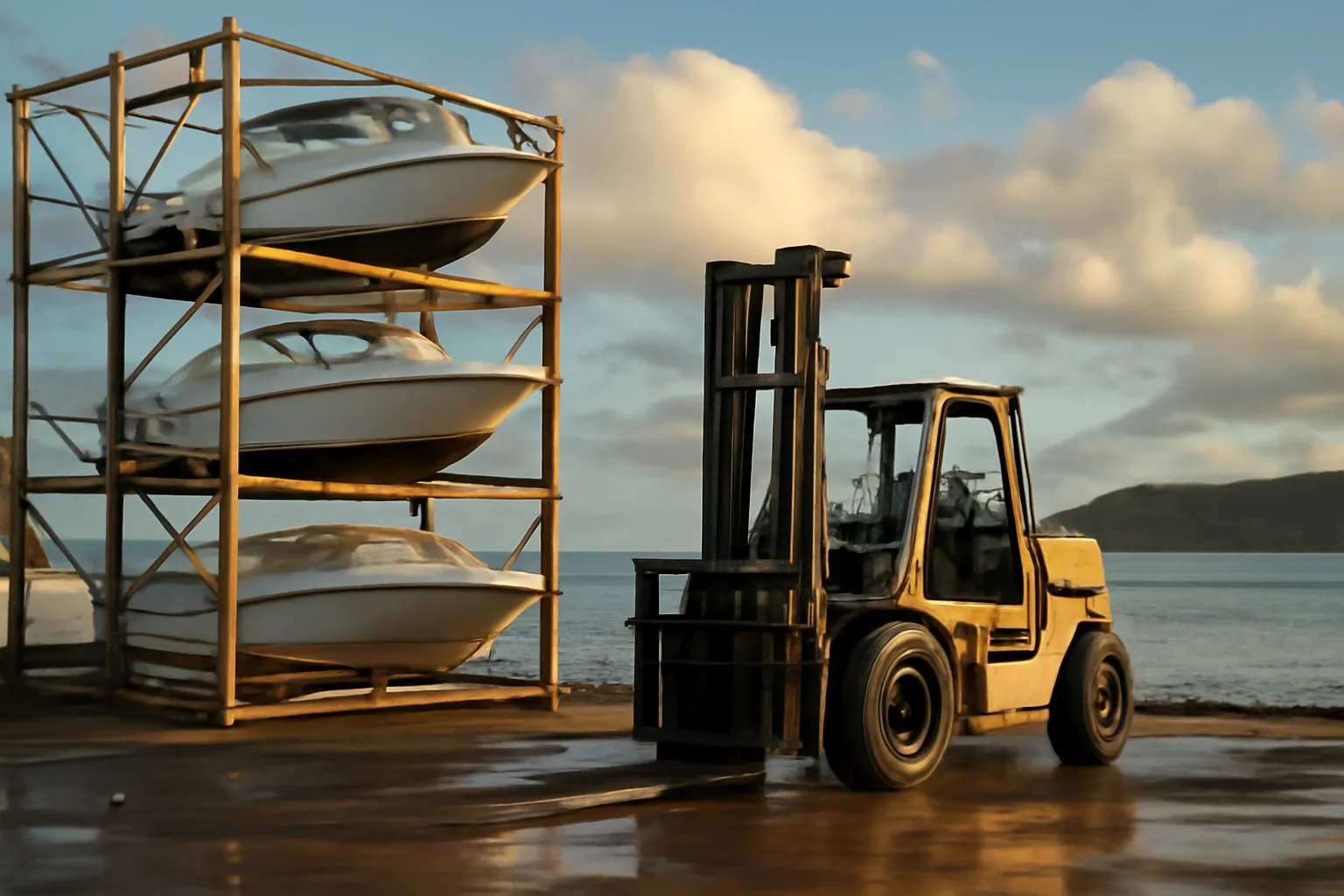
A dry stack is a rack building plus a launch path. The State treats those pieces under different statutes. Storage on private upland is mostly a county land-use and building problem. Launching across a state ramp or mooring in a state basin is a DOBOR problem. Work in the water is a federal and Clean Water Branch problem.
HRS §200-10 is blunt about harbors: "No person shall moor a vessel in a state small boat harbor without: (1) First obtaining a use permit from the department; and (2) Being the owner of the vessel."[1]
That sentence is about mooring, not about racks. Operators still trip on it when the launch plan runs through Ala Wai, Keehi, Honokohau, or another state facility.
Store boats on a private lot and let customers trailer out the gate, and you may never talk to DOBOR about a commercial harbor permit. You still talk to the county. You still collect GET.[5]
I would not hire anyone who promises a Hawaii marina license without a statute number. If they cannot point to HRS 200, 205A, 237, or a county SMA rule, keep walking.
How much does a dry stack marina cost in Hawaii?
Nobody publishes an official statewide price for a dry stack marina in Hawaii. The State does not sell a turnkey rack permit with a sticker price. Your number is land or lease, steel, a marine forklift, power, drainage, and the tax you keep paying after you open.
Hawaii's general excise tax rate is 4 percent for most business activities, per the Department of Taxation.[5] Counties may add a 0.5 percent surcharge, which is why many receipts show 4.5 percent. Confirm the surcharge on your island before you print rate cards.[5][6]
Construction is the expensive part. I will not invent a per-slip figure. Shipping to the islands and scarce industrial waterfront lots push bids around. Get two local bids. Throw out mainland unit costs you saw on a forum.
Recurring cost is clearer. GET on storage rent and launch fees. Property tax on the improvements. Workers' compensation if you have employees, because HRS chapter 386 is not optional.[11] Insurance for the yard, hulls in your care, and the lift. Electricity. Permit renewals whose dollar amounts you confirm with the board that issued them.
If you only need a worksheet for forklift, insurance categories, and slip math, DryStackPath sells a $199 one-time Forklift + Insurance + Slip-Math Kit at /start. It is a publisher kit, not a filing service and not legal advice.
Waste of money: a mainland marina consultant guessing SMA timelines, then reprinting the binder for the county. Pay a local land-use attorney or planner for the SMA piece.
How long does a dry stack marina take in Hawaii?
There is no statewide clock. The State does not publish a guaranteed number of days for dry stack marina approval, because that is not one application. Your total time is the slowest permit in the stack. That is usually SMA or in-water work, not the GET license. No article gets to promise you a season.
GET and DCCA filings are the fast paper. You can form an LLC and apply for a GET license while the county is still reading your SMA file.[5][9]
County SMA major permits need public notice and a hearing under HRS chapter 205A.[3][4] That calendar belongs to the planning commission on your island. I have seen people plan for many months. I will not quote a fake average. Ask the planner assigned to your TMK for the current hearing queue.
Building permits start after land-use entitlements are clean enough for the county to accept plans. Structural, fire, electrical, and drainage comments come back in rounds. Salt-air steel details draw extra questions. Budget revision time.
If you need a USACE permit or a DOH water quality certification for in-water work, that path runs on its own clocks. Confirm with Honolulu District and the Clean Water Branch.
DOBOR commercial or use permits follow harbor rules and vacancy. Harbor space is political. Do not assume a launch window exists because your racks are already welded.
A rebuild or equipment swap on an existing yard can beat a greenfield if you stay inside prior SMA conditions. Cross a condition and you are in a new permit. Read the old SMA before you order steel.
What does DOBOR actually control at a Hawaii dry stack?
DOBOR controls state small boat harbors, many ramps, and vessel registration. It does not zone your private rack building. If your Hawaii dry stack marina plan uses a state harbor for staging, launch, or customer mooring, you are inside HRS chapter 200.[1][2]
HRS §200-9 sets the purpose of state small boat harbors. Recreational boating is the core use. Commercial activity is allowed only as the statute and the rules permit.[2] Read the current text. Amendments have tightened commercial use more than once.
A use permit is not a suggestion. HRS §200-10 says you do not moor without one.[1] Commercial activity inside a harbor typically needs a commercial use permit under the administrative rules DLNR adopted through HRS §200-4.[14] I am not going to paste a fee from an old PDF. Fee chapters get amended. Confirm the live schedule with DOBOR.
Renewal here means keeping that harbor permit current, paying whatever the current invoice says, and staying inside the activity description. Move from storage-and-launch to fuel or repair and you may have a different permit problem.
If the whole operation stays on private land and customers never enter a state harbor under your business, DOBOR may only see you when customers register boats. That is a different desk.
| Paper | Private upland dry stack | Uses a state small boat harbor |
|---|---|---|
| DCCA entity and GET | Yes | Yes |
| County SMA and building | Usually, if you develop the lot | For any landside development |
| DOBOR use or commercial permit | No, unless you also use the harbor | Yes, to moor or run commercial harbor activity |
| HRS 171 state lease | Only if the lot is state land | Common on harbor backlands |
People still call DOBOR for a marina license and get bounced. Call with a harbor name and a use, not a vibe.
Compare this to how dry stack marina renewal in California splits coastal commission paper from harbor district slips. Same idea, different statute numbers.
When does an SMA permit show up on dry stack renewal?
If your racks, pavement, or shoreline work sit in the special management area, HRS §205A-28 is the gate. "No development shall be allowed in any county within the special management area without obtaining a permit in accordance with this part."[3]
Most Hawaiian waterfront industrial lots are inside the SMA. Assume you are in until the county map says you are not.
Renewal is not always a new SMA. Many SMA use permits run with conditions, expiration dates, or both. Some are silent on term and stay alive if you do not change the development. Some require periodic compliance reports. I would pull the recorded permit and the findings before I budget a simple renewal.
HRS §205A-26 tells counties to hang reasonable terms on SMA approvals, including protection of coastal resources and public access.[4] Those terms are what bite you at year five when you want another rack row.
A like-for-like forklift swap is usually not development. A taller rack, a bigger footprint, new shoreline armoring, or a new launch well usually is. When in doubt, ask the county in writing with a site plan.
SMA minor versus major is a county valuation and impact call. Thresholds move. Confirm the current dollar cut with Honolulu DPP, Maui Planning, Kauai Planning, or Hawaii County Planning. Do not use a number you memorized in 2018.
If federal permits are in play, Hawaii CZM federal consistency review can sit on top.[13] That is a state planning office process, not a county sticker.
What tax and business filings come due every year?
Your entity has to stay alive at DCCA. LLCs file periodic annual filings on the Business Registration calendar. Confirm due dates and the current filing fee on the BREG LLC page before you ignore a notice.[9]
GET is the tax that actually follows revenue. You file periodic GET returns and pay 4 percent on most gross proceeds, plus the county surcharge if it applies.[5][6] Dry storage rent is generally business income, not a hidden exemption. If someone tells you boat storage is wholesale at 0.5 percent, make them show you the HRS 237 paragraph. Most yard rent lands in the 4 percent bucket.
I would put GET in the bookkeeping software on day one. Late GET is how small yards get ugly fast.
General excise is on gross, not profit. Empty racks still do not create a GET holiday. They just leave you paying fixed costs.
County property tax bills follow the real property classification. Industrial versus commercial rates differ by county. Confirm the class on your assessment notice. Appealing class is sometimes worth it. Fancy landscaping rarely changes the tax map.
If you lease state land, ground rent reviews can dwarf GET. Those reviews live in the lease, not in a blog.
Keep the GET license number on customer invoices. Auditors can read.
What OSHA, forklift, and insurance paper stays current?
A dry stack is a powered industrial truck operation next to the ocean. OSHA 29 CFR 1910.178 is the rule that follows the lift, and HIOSH enforces the federal standards in Hawaii. The employer has to make sure each operator is competent, shown by the training and evaluation in paragraph (l) of that standard.[7]
Hawaii does not hand out a separate state forklift license for marina work. Your file is training records, evaluations, and a truck that still matches the capacity plate. Salt, wet hulls, and wind are not in the standard's happy path. Train for them anyway.
Workers' compensation coverage is required for employees under HRS chapter 386.[11] A one-person member-managed LLC can slip into gray zones. Talk to the Disability Compensation Division or a local agent before you decide you are exempt. I would not run a lift crew without a policy.
Insurance itself is not a state marina license. Lenders and landlords will still ask for yard liability, care-custody-control or marina operator legal liability, and equipment coverage. Premiums are private quotes. Nobody has a clean public data set for Hawaii dry stack rates that I trust.
Renew the certificates before the lease or the harbor permit expires. Harbor managers love expired COIs. They will lock a gate.
If you want a side-by-side of how another coastal state treats lift paper, dry stack marina renewal in Alaska is a useful contrast. Different weather. Same forklift standard.
Is a state land lease harder than a private lot?
Private fee-simple industrial land is simpler on paper. You still need county zoning that allows outdoor storage, boat yards, or warehousing. You still need SMA if you are in the map. You do not need a Board of Land and Natural Resources lease.
State land is HRS chapter 171. Lease restrictions, including use and term rules, sit in HRS §171-36.[12] Read your lease. Rent reopeners, performance bonds, and assigned-use clauses will control your renewal more than the building permit.
A dry stack on harbor backlands can be a great location and a slow political file. Board agendas are public. I would watch the BLNR calendar before I wired a deposit.
County harbor property (a few facilities are city or county, not DOBOR) has its own lease desk. Ala Wai is state. Keehi has a mix of histories. Do not guess tenure from a satellite photo.
Subleases often need the landowner's written consent. If your renewal is actually a transfer, you may be in assignment review, not a rubber stamp.
Waste of money: option payments on a state parcel before you know whether the existing executive order or harbor purpose even allows dry storage. Have a local real estate attorney read the encumbrances.
Florida's private-yard model in dry stack marina renewal in Florida is not how Hawaii state harbors work. Do not import it.
Which stormwater permits do you still file after opening?
If you disturb enough ground to trigger HAR chapter 11-55 during construction, you file a construction NPDES notice. Confirm the current acreage trigger and appendix with the Clean Water Branch.[8]
After you open, industrial stormwater can still apply. Boat storage, washing, and maintenance drain to harbors. EPA's Multi-Sector General Permit framework is the national template. Hawaii runs its own general permits through DOH.[8][10]
I would treat hull wash water as a real discharge problem, not a broom issue. Copper bottom paint and oil do not impress inspectors.
Renewal here is an annual report, a SWPPP that matches the yard you actually run, and a re-NOI when the general permit is reissued. People forget the reissuance year and operate on an expired coverage letter. That is a bad day.
If you add a travel lift well or a ramp in navigable waters, USACE Section 10 and sometimes Section 404 show up, plus a Section 401 water quality certification. Those are not renew-the-GET chores. They are project permits.
A rack-only rebuild on existing pavement with no new outfall is simpler. Still ask CWB in writing. Verbal you should be fine disappears when staff rotate.
dry stack marina renewal in Georgia and other Clean Water Act states use the same federal bones. Hawaii's coastal SMA layer sits on top.
How do the four counties handle the same dry stack stack?
Hawaii has one SMA statute and four planning departments. That is the whole game on land.
City and County of Honolulu runs SMA and building permits for Oahu. Expect urban infrastructure comments, flood and tsunami maps, and neighbors who can read a hearing notice. Industrial waterfront around Keehi and Sand Island is the usual dry stack conversation. Confirm zoning with DPP, not with a broker flyer.
Maui County includes Molokai and Lanai. SMA politics on Maui are loud. Harbor capacity is tight. I would not assume a Kahului-area rack plan is a building-permit-only job.
Kauai County has a smaller staff, same HRS 205A. Coastal setbacks can be the killer, not the rack design.
Hawaii County (the Big Island) has Honokohau and other DOBOR facilities plus private lots in Kona and Hilo. Lava hazard zones and drainage toward sensitive coastal ponds are local issues you will not see on an Oahu checklist.
Building codes sit in the same state-adopted family, but amendments and fire review differ. Forklift aisle widths that passed in one county can draw a comment in another.
I would hire the planner who has filed SMA on your island in the last two years. A Honolulu specialist on a Kauai lot is often a waste.
For a mainland county-split comparison, dry stack marina renewal in Illinois is a different legal world, but the which-local-desk lesson holds.
What would I file first if I were starting or renewing?
I would pull three documents before I paid an architect. The recorded SMA (or a county letter that you are outside the SMA). The deed or DLNR lease. The current DOBOR permit if any harbor use exists.
Then I would register or revive the entity at DCCA and confirm the GET license is active.[5][9] Dead entities with live customers is how GET audits start.
Then I would write the county a pre-application letter with a one-page site plan. Ask whether the next rack row is a new SMA, a minor modification, or nothing. Get the answer in email.
Then I would price insurance and workers' comp. If the premium makes the pro forma ugly, stop. Steel can wait.
Only then would I bid the forklift and the rack steel. Equipment lead times are long. Permits are longer. Buying the lift first is a common way to burn cash in a yard that cannot yet operate.
If you operate in more than one state on paper, keep Hawaii files separate. dry stack marina renewal in Arizona will not teach you SMA. dry stack marina renewal in Colorado will not teach you DOBOR.
Confirm every fee with the cashier who deposits it. I will not invent a current SMA filing fee, a DOBOR commercial invoice, or a building-permit valuation rate. Those move.
What usually stalls a Hawaii dry stack marina renewal?
Expired insurance certificates. SMA conditions nobody read since the original owner. A GET license that still shows the old trade name. A harbor permit that listed mooring when you are now running daily launches for a full rack building.
Staffing is the other stall. One qualified lift operator on vacation and the yard is a parking lot. Cross-train. Keep the OSHA evaluations in a folder that someone besides the owner can find.
Harbor politics stall people who needed DOBOR more than they admitted. If your business model is we will sort the ramp later, you do not have a business model.
Coastal hazards stall rebuilds after storms. Rebuild bigger and you may have a new SMA. Rebuild exactly and you may still need flood and building review. Photograph the pre-storm racks.
DryStackPath is an independent publisher, not a law firm and not a Hawaii permit desk. Use this as a map. File with the board. If you want the $199 worksheet for lift categories, insurance labels, and slip math, it is at /start.
People who treat renewal as an annual three-hour chore stay open. People who treat it as a vibe eventually meet an inspector.
For another state's renewal mess, dry stack marina renewal in Connecticut shows how a different coastal statute stack feels. Same boats. Different paper.
Frequently asked questions
Do you need a license for dry stack marina in hawaii?
No single license exists. You register the entity at DCCA, open a GET account, and keep county zoning, building, and often SMA paper current. If you moor or run commercial activity in a state small boat harbor, you also need a DOBOR permit under HRS chapter 200. Confirm each desk's current form. None of this is a wall plaque called a dry stack license.
How much does dry stack marina cost in hawaii?
There is no official state price list. Build cost is whatever local contractors bid for racks, foundations, and a marine forklift, plus land or lease. After opening, budget GET at 4 percent (plus any county surcharge), property tax, workers' compensation, insurance, and the live permit invoices. Confirm every fee with the cashier. Ignore mainland per-slip averages.
How long does dry stack marina take in hawaii?
There is no statewide clock and no approval guarantee. GET and DCCA filings are the quick paper. SMA major review with a hearing is usually the long pole, followed by building permits. In-water work adds USACE and DOH time. Ask the planner on your TMK and DOBOR at the named harbor for the current queue.
Is a DOBOR permit required if I only store boats on private land?
Often no. DOBOR's use and commercial permits attach to state small boat harbors and related facilities under HRS chapter 200. Private upland storage with customers trailering out the gate is mostly county land-use, building, tax, and stormwater paper. The minute your operation uses a state ramp, basin, or harbor staging area, call DOBOR before you sell that service.
Does Hawaii GET apply to dry storage rent?
Plan on yes. The Department of Taxation states the GET rate is 4 percent for most business activities, and HRS 237 taxes gross proceeds. Yard rent and launch fees usually sit in that bucket, plus any county surcharge. If a bookkeeper claims a wholesale 0.5 percent rate, make them cite the exact paragraph. Confirm with DOTAX if your mix includes parts sales.
Does Hawaii issue a marine dealer or marina operator license?
There is no statewide marina operator card that replaces SMA, GET, and DOBOR. Customer boats may still need DOBOR registration, which is their paper, not your operator license. Selling boats, fuel, or repairs can add other tax and environmental files. Ask DCCA and the county what your actual activity list triggers. Do not buy a fake license package.
Can I renew an SMA instead of starting over?
Sometimes you are not renewing at all. You are showing you still match the old conditions. Some SMA permits expire. Some do not. A footprint change, taller racks, or new shoreline work can force a new application. Pull the recorded permit and email the county planner with a marked site plan before you order steel.
Are forklift operators licensed by the State of Hawaii?
No separate Hawaii marina forklift license exists. OSHA 29 CFR 1910.178 requires employer-run training and an evaluation for each powered industrial truck operator. Keep those records. HIOSH can ask for them. A driver's license or CDL is not a substitute for the evaluation on that specific lift.
Do I need a CDL to drive the marina forklift?
A CDL is a highway commercial-driver rule, not the yard rule. Inside the rack building and on private pavement, the live requirement is OSHA 1910.178 competence on that truck. If you drive a truck-trailer combo on public roads, that is a different license question. Confirm with your insurer and HIOSH trainer, not with a dock rumor.
What if my racks are in the conservation district?
Then SMA is not your only land desk. Conservation district use is a DLNR Office of Conservation and Coastal Lands problem on top of anything the county runs. I would stop design work until OCCL or a local land-use attorney maps the district line on your TMK. Building first and asking later is how projects die.
Does CZM federal consistency apply to a rack rebuild?
It can, if a federal permit or funding is in the mix. Hawaii's CZM office reviews federal consistency for listed activities. A pure inland rack swap with no USACE permit may never see that desk. A new launch well in navigable water often will. Ask the CZM federal consistency staff with a one-page project description.
Where do I confirm current DOBOR fees and forms?
With DOBOR, for the named harbor, using the current fee chapter and commercial-use instructions they hand you. HRS 200 authorizes permits and rules. The dollar line on an old PDF is not a filing number. Call the harbor office and the Oahu or neighbor-island DOBOR permit desk. Get the invoice in writing.
Sources
- Hawaii Revised Statutes §200-10, Permits and fees for state small boat harbors: No person may moor a vessel in a state small boat harbor without first obtaining a department use permit and being the vessel owner.
- Hawaii Revised Statutes §200-9, Purpose and use of state small boat harbors: State small boat harbors are established for recreational boating and other uses set out in the statute, with commercial activity limited by that chapter.
- Hawaii Revised Statutes §205A-28, Permit required: No development is allowed in any county special management area without obtaining a permit under HRS chapter 205A part II.
- Hawaii Revised Statutes §205A-26, Special management area guidelines: Counties must review SMA developments under statutory guidelines and may attach reasonable terms and conditions.
- Hawaii Department of Taxation, General Excise Tax (GET): The GET rate is 4% for most business activities, and counties may add a surcharge that operators must confirm locally.
- Hawaii Revised Statutes §237-13, Imposition of tax: Hawaii imposes general excise privilege taxes on business gross proceeds at the rates set out in HRS 237-13, including the four percent rate on many activities.
- OSHA 29 CFR 1910.178, Powered industrial trucks: Employers must ensure each powered industrial truck operator is competent through the training and evaluation required in 1910.178(l).
- Hawaii Administrative Rules chapter 11-55, Water Pollution Control (NPDES), Hawaii Department of Health Clean Water Branch: Hawaii's Clean Water Branch administers NPDES construction and industrial stormwater general permits under HAR chapter 11-55.
- Hawaii Department of Commerce and Consumer Affairs, Business Registration Division: Hawaii LLCs and other entities register and file periodic annual reports with the DCCA Business Registration Division.
- U.S. EPA, 2021 Multi-Sector General Permit for industrial stormwater: EPA's MSGP is the national industrial stormwater template that Hawaii implements through its own NPDES general permits.
- Hawaii Revised Statutes §386-3, Injuries covered: Hawaii workers' compensation law covers employees for work injuries under HRS chapter 386.
- Hawaii Revised Statutes §171-36, Lease restrictions; generally: Public land leases are subject to the use, term, and other restrictions in HRS 171-36.
- Hawaii Office of Planning and Sustainable Development, CZM federal consistency: Hawaii's Coastal Zone Management program reviews federal consistency for listed federal permits and activities.
- Hawaii Revised Statutes §200-4, Rules: DLNR is authorized to adopt rules for ocean recreation and state small boat harbors, which is the hook for DOBOR commercial and use-permit rules.